

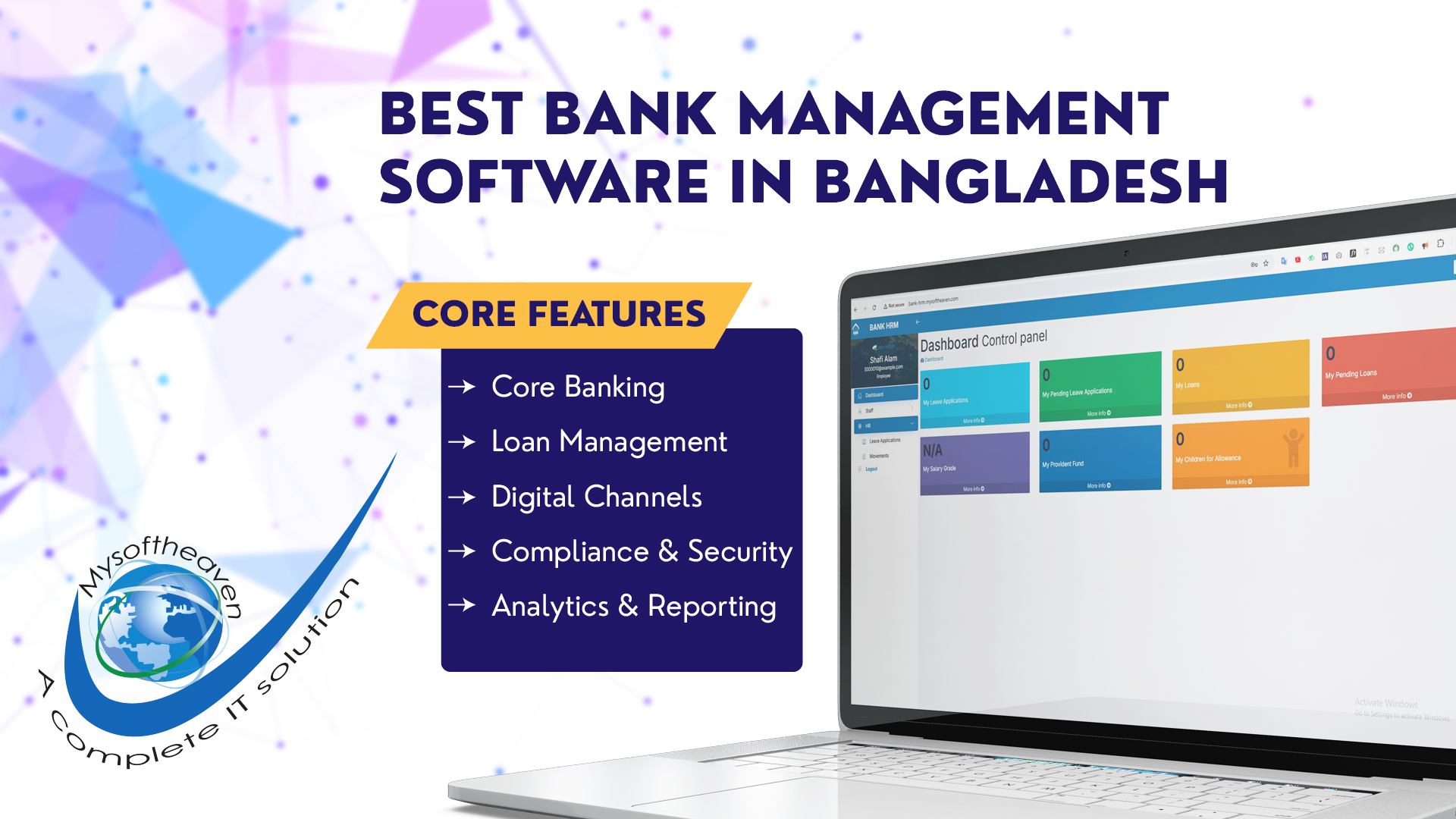
Bank Management Software in Bangladesh

Bank Management Software in Bangladesh

Bank Management Software in Bangladesh 

The Dawn of Digital Banking in Bangladesh

Bangladesh’s banking sector has undergone an astonishing transformation over the past two decades. What was once a primarily brick‑and‑mortar industry—reliant on ledgers, manual cash balancing, and long queues—has evolved into a vibrant digital ecosystem. At the heart of this transformation lies one powerful engine: Bank Management Software in Bangladesh.
Today, Bank Management Software in Bangladesh in Bangladesh has become the backbone of almost every financial institution—enabling efficiency, compliance, risk control, and seamless customer experiences across branches and digital channels.

In this comprehensive article, we dive deep into what Bank Management Software in Bangladesh is, how it has evolved locally, the leading Bangladeshi vendors, implementation challenges, government regulations, and the exciting future that awaits this rapidly growing field.


What Is Bank Management Software in Bangladesh?

Bank Management Software in Bangladesh (BMS) refers to a suite of integrated digital tools that help financial institutions manage their daily operations—deposit management, loan tracking, transaction processing, customer relationship handling, accounting, regulatory reporting, and digital service delivery.

Essentially, it is the central nervous system of a bank’s operations. Whether a customer deposits money, requests a loan, or checks their mobile balance, the back‑end system handling those operations is the management software.

A robust bank management system typically includes:

  1. Core Banking Module: Handles deposits, withdrawals, fund transfers, account management, and interest calculation in real time.
  2. Credit and Loan Management: Tracks loan applications, disbursements, payments, and defaults.
  3. Customer Relationship Management (CRM): Captures and analyzes customer interactions to optimize service.
  4. Risk and Compliance Tools: Ensures adherence to Bangladesh Bank regulations, anti‑money laundering (AML) checks, and audit trails.
  5. Digital Banking Integration: Enables mobile banking, agent banking, internet banking, and ATM management.
  6. Reporting and Analytics: Provides real‑time dashboards, profitability analysis, and management reports.

These systems are the reason customers can transfer money within seconds or get instant SMS notifications—a task that a few decades ago required paper slips and manual verifications.


The Evolution of Banking Technology in Bangladesh

The Early Stage (1990s – Early 2000s)

In the 1990s, most banks in Bangladesh recorded transactions manually. Account ledgers were handwritten, and reconciliation took days. Slowly, the introduction of computers for accounting tasks began easing certain operations. However, full‑scale automation was rare and localized.

The Rise of Core Banking Solutions (2005 – 2015)

During this phase, commercial banks started investing in core banking systems (CBS). These centralized platforms replaced traditional branch‑based systems and allowed real‑time transaction updates across all outlets.
Private commercial banks such as BRAC Bank, Dutch‑Bangla Bank, and Eastern Bank pioneered digital initiatives, setting new benchmarks for speed and service quality.

The Digital Transformation Era (2016 – Present)

The last few years witnessed an immense leap. The Bangladeshi government’s “Digital Bangladesh” vision accelerated automation in financial institutions. The growing adoption of smartphone banking, fintech collaborations, and the emergence of cloud‑based local vendors made advanced software solutions accessible even to smaller banks.

Today, with almost every bank running on sophisticated management systems, the focus has shifted from mere automation to innovation—AI‑driven risk analytics, predictive credit scoring, and data‑driven decision‑making.


Why Bank Management Software in Bangladesh Matters

1. Facilitating Financial Inclusion

Bangladesh has over 180 million people, yet financial inclusion remains a work in progress. Bank Management Software in Bangladesh enables services like agent banking, mobile wallets, and microfinance integration, reaching rural and remote customers at minimal operational cost.
For example, cooperative banks and microfinance institutions now use simplified management modules to digitize savings and loan records, improving transparency and efficiency.

2. Ensuring Regulatory Compliance

Bangladesh Bank issues comprehensive circulars on KYC (Know Your Customer), AML (Anti‑Money Laundering), fraud management, and audit standards. Manual enforcement of such compliance is complex.
Bank Management Software in Bangladesh automatically enforces these checks, ensuring that every transaction—whether a remittance inflow or a local fund transfer—meets national and international standards.

3. Enhancing Operational Efficiency

Automation reduces repetitive manual work. With automatic reconciliation, digital ledger balancing, and paperless workflows, staff can focus on customer engagement and innovation rather than clerical tasks.
In addition, systems with multi‑branch synchronization minimize data duplication—a major issue before centralization.

4. Strengthening Data Security

Modern Bangladeshi banking software now emphasizes cybersecurity. Since cyber threats are growing, banks are investing in encryption, firewalls, and intelligent monitoring built directly into their management systems.

5. Empowering Decision‑Makers

Managers can access dashboards showing real‑time performance metrics—branch profitability, delinquent loans, liquidity ratios, and customer satisfaction indicators. Data analytics has become an executive’s compass in navigating a highly competitive marketplace.


Top Features Banks in Bangladesh Look For

When Bangladeshi banks evaluate a software system, they usually seek a combination of technical stabilitycompliance readiness, and local adaptability.
Key features include:

  • Bilingual Interface (English and Bangla) – to enhance accessibility for local staff.
  • Regulation‑friendly reporting – automatic submission of Bangladesh Bank returns, income tax data, and quarterly financial summaries.
  • Multi‑channel integration – seamless connection with ATMs, SMS gateways, Internet banking, mobile wallets, and agent outlets.
  • Scalability – ability to handle data from hundreds of branches and millions of customers.
  • Disaster recovery and data backup – crucial for business continuity.
  • User access controls – ensuring secure and authorized system usage.
  • Customizable dashboards – each bank has unique reporting preferences.

Leading Local Vendors of Bank Management Software in Bangladesh

The banking software ecosystem in Bangladesh now boasts several domestic technology providers who compete with international giants through localization, cost‑effectiveness, and dedicated support.
Here are some notable names that are helping reshape the financial landscape.


1. Leads Corporation Limited

Leads Corporation is one of the pioneers in Bangladesh’s IT solutions industry. Their flagship product, BankUltimus, serves many leading local banks. It covers a full core banking suite—deposit management, loans, trade finance, AML modules, and digital channel integration.
What sets Leads apart is its deep understanding of local banking regulations and consistent post‑implementation support.

Key Strengths:

  • Tailored for Bangladeshi compliance standards
  • Bilingual user interface
  • Flexible deployment models (on‑premise or cloud)

2. Millennium Information Solution Ltd.

Millennium’s BankEasy platform has become a familiar name across mid‑sized commercial banks. Known for its robust architecture and quick customization, BankEasy offers a modular design covering retail banking, treasury, trade, and credit management.

Highlights:

  • Multi‑branch online synchronization
  • Integrated AML/KYC features
  • Advanced reporting engine
    Millennium’s clients appreciate its continuous software improvement and quick response time for regulatory updates.

3. CBL Technologies

Specializing in microfinance and cooperative bank automation, CBL Technologies delivers affordable, cloud‑based banking solutions for small and medium‑scale institutions. Its software provides intuitive interfaces, making it ideal for organizations transitioning from manual record‑keeping to digital platforms.


4. Synesis IT Limited

Synesis IT offers enterprise‑grade digital banking tools including CBS and electronic payment workflow modules. It has collaborated with several government initiatives and focuses heavily on cybersecurity and data visualization.


5. Dohatec New Media

Dohatec, a respected name in secure e‑Government systems, has developed custom‑engineered solutions for financial institutions emphasizing digital signatures, encryption, and secure document management.
While not a core banking vendor primarily, its technology complements BMS infrastructure with secure communication and authentication tools.


6. DataSoft Systems Bangladesh Ltd.

DataSoft is the first Bangladeshi CMMI Level‑5 software company. Their banking automation tools emphasize scalability, analytics, and user‑friendly dashboards. DataSoft has also partnered with multiple financial institutions for digital payment ecosystems.


7. Southtech Limited

Southtech’s Ababil Core Banking Solution stands out as one of the most recognized local BMS platforms. Designed specifically for Islamic banking and microfinance, it adheres to Shariah‑compliance principles and provides modules for deposit products, investment accounts, and profit distribution.
Southtech’s success story reflects Bangladesh’s growing capacity for exporting financial software—Ababil is now used beyond Bangladeshi borders.


Success Stories: Local Banks Going Digital

Case Study 1: BRAC Bank Limited

BRAC Bank, one of Bangladesh’s leading private commercial banks, has consistently embraced technological innovation. With an advanced management software backbone linked to digital and mobile channels, the bank serves millions while minimizing manual intervention. Its systems enable instant inter‑branch connectivity and real‑time transaction updates—key to its acclaimed service quality.

Case Study 2: Islami Bank Bangladesh Limited

As Bangladesh’s largest Islamic bank, IBBL has heavily invested in Shariah‑compliant digital banking modules. Through custom software integration, it now provides ATM, internet, and mobile services fully supported by centralized management tools, ensuring efficiency even in remote rural branches.

Case Study 3: Eastern Bank Limited

Eastern Bank’s core system, integrated with comprehensive CRM and business intelligence tools, empowers them to make data‑based strategic decisions. This case reflects how modern software directly influences profitability and market responsiveness.


Challenges in Adopting Bank Management Software in Bangladesh

While progress is impressive, several hurdles remain:

1. High Implementation Costs

Deploying a full‑fledged core banking system can be expensive. Smaller banks or cooperative societies struggle with hardware investment, license fees, and staff training expenses.
The emergence of cloud‑hosted platforms, however, is mitigating this barrier gradually.

2. Limited Skilled Workforce

Despite Bangladesh’s thriving IT industry, banking technology requires niche expertise—data security, system integration, and compliance reporting. The workforce gap often affects implementation speed.

3. Cybersecurity Threats

As digitalization increases, so does vulnerability to cyberattacks. Banks must continuously update security policies, conduct penetration testing, and train staff to avoid breaches.

4. Legacy System Integration

Many older banks still maintain fragmentary systems for specific services. Integrating those with modern and centralized management software remains technically challenging.

5. Change Management

Beyond technology, human adaptation is critical. Shifting long‑time employees from manual work to software‑based processes requires patience, training, and trust building.


Regulatory and Compliance Context

Bangladesh Bank’s Role

As the central bank, Bangladesh Bank (BB) plays a vital role in ensuring stability and integrity within the financial sector. It mandates that all banks maintain proper IT security, data recovery arrangements, and transaction monitoring frameworks.
Software vendors must constantly update their systems to comply with BB’s circulars on risk, prudential regulations, and international standards like Basel III.

Data Protection and Cybersecurity

The Digital Security Act and forthcoming Data Protection Act have direct implications for financial institutions. Bank Management Software in Bangladesh now includes data classification, encryption, audit logs, and strict access control to adhere to these legal frameworks.

Interoperability Initiatives

Bangladesh Bank also supports digital payment gateways and interoperability systems (e.g., NPSB – National Payment Switch Bangladesh) to connect ATMs, POS, and mobile wallets across banks. Software vendors must ensure compatibility with those systems during implementation.


Cloud‑Based vs On‑Premise Solutions: The Current Debate

On‑Premise Systems

Traditionally, Bangladeshi banks hosted management software on their own servers. This provided complete control but demanded significant hardware investments, physical security, and dedicated IT support.

Cloud‑Based Systems

The new wave is cloud computing.
Cloud‑based Bank Management Software in Bangladesh allows flexible scaling—paying only for what the bank uses. Smaller MFIs and cooperative organizations find this model appealing due to lower cost and easy maintenance.

Advantages of Cloud in Banking:

  • Reduced infrastructure cost
  • Faster deployment
  • Automatic updates from vendors
  • Improved accessibility for remote branches

However, compliance‑conscious banks often worry about data residency and control, requiring careful policy alignment with central bank guidelines.


How Artificial Intelligence Is Reshaping Bank Management Software in Bangladesh

Artificial intelligence (AI) is no longer the stuff of science fiction in Bangladesh’s banks—it is quietly powering credit scoring, fraud detection, and customer support chatbots.

AI in Credit Risk Analysis

AI‑enabled modules within Bank Management Software in Bangladesh analyze historical repayment data to predict loan performance, reducing default risks.

AI in Customer Service

Chatbots and virtual assistants integrated into digital banking channels utilize natural language processing (NLP) to provide instant responses—cutting down operational load.

Predictive Analytics for Decision‑Making

Software vendors now incorporate data science features that highlight trends: which branches are growing fastest, which sectors are credit‑worthy, and even which customer groups may soon require new products.


Mobile and Agent Banking Integration

With millions of users relying on mobile phones, integration between bank management systems and mobile banking platforms has become vital.

Agent Banking Growth

As of recent years, agent banking accounts have skyrocketed. Bank Management Software in Bangladesh must support real‑time transaction monitoring for agents, ensuring adherence to limits, security, and audit requirements.

Interoperability with Mobile Financial Services (MFS)

Banks partner with services like bKashNagad, and Rocket to extend reach. Behind this partnership lies software capable of seamless API communication—ensuring transactions reflect instantly across both ecosystems.


Training and Capacity Building

Technology succeeds only when people know how to use it.
Leading banks in Bangladesh invest significantly in staff training—core banking operations, cybersecurity awareness, and data analytics literacy.

Local vendors often provide post‑deployment workshops covering:

  • System navigation and standard operating procedures
  • Troubleshooting common issues
  • Reporting customization
  • Change management strategies

Continuous education helps maintain software effectiveness and ensures compliance with evolving guidelines.


The Link Between Bank Management Software in Bangladesh and Financial Innovation

Without advanced software infrastructure, innovation like digital lendingautomated teller management, and open banking APIs wouldn’t exist.
As fintech startups collaborate with established banks, they rely on well‑structured management systems for secure data exchange.

Examples of Innovation:

  • Instant Microloans: Banks now automate loan approval and disbursement through digital channels within minutes.
  • Digital KYC Systems: Paperless customer onboarding reduces fraud and account opening times.
  • Data‑Driven Financial Products: Analytics from core systems inspire target‑specific savings and insurance schemes.

Thus, robust Bank Management Software in Bangladesh is the silent, indispensable partner behind every flashy finance app.


Opportunities for Local Vendors

Bangladesh’s technological talent pool and strong domestic market create fertile ground for local software providers.

Export Potential

Vendors like Southtech and Leads are already exporting banking solutions to other Asian and African markets—showing the potential of homegrown systems going global.

Government Support

Initiatives from the ICT Division and BASIS (Bangladesh Association of Software and Information Services) highlight the government’s commitment to nurturing software export and digital infrastructure.

Collaboration with Fintech and Cloud Providers

Local firms are partnering with telecoms and global cloud services to deliver hybrid models—combining local regulatory insight with global technological sophistication.


Customer Experience and Predictive Personalization

In the era of customer‑centric banking, management software has evolved from being just an operational tool to a relationship engine.
By analyzing user behavior, banks curate personalized product recommendations and targeted communications.

For instance:

  • A customer frequently transferring funds to pay tuition abroad might automatically receive educational loan offers.
  • A SME account exhibiting stable growth may get tailored credit limit enhancements.

These subtle data insights, enabled by modern software, transform the banking experience from transactional to relational.


Sustainability and Green Banking

The conversation around sustainable banking is gaining traction. Paperless workflows, reduced energy consumption through efficient data centers, and automated reporting on green financing are now integrated within Bank Management Software in Bangladesh.

Bangladesh Bank already encourages “green banking reports,” and management systems simplify their preparation—helping institutions align profitability with environmental responsibility.


The Future: Towards Open Banking and Blockchain Integration

Open Banking Prospects

Open Banking—a framework where customers can securely share their financial data with third‑party apps—represents the next frontier.
While still nascent in Bangladesh, policy discussions have begun. Future management software will need robust API management, authorization protocols, and consent tracking mechanisms.

Blockchain and Smart Contracts

Blockchain‑integrated modules may soon revolutionize trade finance and remittance settlements, reducing fraud and enhancing transparency. Some pilot initiatives are already underway within regional consortiums.


Strategic Recommendations for Banks

  1. Adopt a Phased Implementation Model: Large‑scale transformation works best with incremental deployment—starting with core modules, then expanding to analytics and digital channels.
  2. Prioritize Cybersecurity and Data Resilience: Invest continuously in encryption, two‑factor authentication, and disaster recovery setups.
  3. Choose Regulation‑Compliant Vendors: Local software providers offer the distinct advantage of staying updated with Bangladesh Bank directives.
  4. Promote Staff Upskilling: No software can perform miracles without human mastery.
  5. Stay Agile: Banking technology evolves fast; choose platforms with regular upgrade paths and strong vendor support.

1. What is bank management software in Bangladesh?

Bank management software in Bangladesh refers to digital systems that help financial institutions automate daily operations such as deposits, loans, accounting, and compliance. It connects all branches, enabling real‑time transactions and reporting under Bangladesh Bank regulations.


2. Why is bank management software important for Bangladeshi banks?

It improves efficiency, strengthens data security, supports regulatory compliance, and enables digital banking channels like mobile and agent banking—helping banks deliver faster, more inclusive service.


3. Who are the leading local vendors of bank management software in Bangladesh?

Some well‑known local companies include Leads Corporation (BankUltimus)Southtech Limited (Ababil)Millennium Information Solution (BankEasy)DataSoft Systems, and Synesis IT. These vendors specialize in solutions tailored for the local banking environment.


4. How does bank management software support financial inclusion in rural Bangladesh?

Through features like agent banking, mobile connectivity, and cloud‑based deployment, even remote branches and cooperatives can now provide efficient financial services, reducing the urban‑rural banking gap.


5. Is cloud banking popular in Bangladesh?

Yes. Many smaller banks, microfinance institutions, and cooperatives are adopting cloud‑based systems due to their lower cost, scalability, and easy maintenance, while still adhering to Bangladesh Bank’s security standards.


6. How does Bangladesh Bank regulate digital banking systems?

Bangladesh Bank issues regular IT and cybersecurity guidelines, ensuring data protection, legal compliance, and financial transparency. Vendors frequently update their software according to these circulars.


7. What future trends will shape bank management software in Bangladesh?

Future developments include AI‑driven analyticsopen banking APIsblockchain integration, and enhanced cybersecurity—ushering in faster, smarter, and more personalized banking experiences.


8. What challenges do banks face when adopting new management software?

Common obstacles include high implementation costs, staff training needs, legacy system integration, and cybersecurity concerns. Strategic planning and vendor collaboration help overcome these issues.


9. Do Bangladeshi banks use local or foreign software systems?

While many banks still use international systems, local vendors have gained strong ground due to their deep understanding of local regulations, lower costs, and superior after‑sales support.


10. How do customers benefit from advanced bank management software?

Customers enjoy faster service, error‑free transactions, 24/7 digital banking access, and improved security—making banking more efficient and transparent than ever before.


Banking Beyond Boundaries

The journey of Bank Management Software in Bangladesh in Bangladesh reflects more than technological progress—it mirrors the nation’s broader stride toward a digital economy. From rural cooperatives adopting cloud systems to major commercial banks employing AI‑powered analytics, the entire sector pulses with innovation.

Local vendors stand at the forefront, creating homegrown solutions finely tuned to Bangladesh’s regulatory, cultural, and operational landscape. This synergy of technology and trust is positioning the country not merely as a follower but a regional pioneer in financial digitalization.

As we move into an era of open APIs, AI‑driven personalization, and blockchain‑integrated transactions, the role of Bank Management Software in Bangladesh will grow even more central—ensuring that banking in Bangladesh remains secure, efficient, inclusive, and brilliantly human.

FAQs

No FAQ Found