

The Best Legacy System Modernization Services for 2026: A Comprehensive B2B Guide
In the rapidly evolving digital landscape of 2026, the mandate for enterprises has shifted from simple digital adoption to total digital agility. For many organizations, the primary hurdle to this agility is the "Technical Debt Fortress"—the accumulated burden of legacy systems that are too critical to shut down but too obsolete to support modern business models. As we navigate the mid-2020s, the demand for high-quality legacy system modernization services has reached an all-time high, driven by the need for AI integration, real-time data processing, and cloud-native resilience. The stakes are no longer just about efficiency; they are about survival in a market where "legacy" often translates to "vulnerability."
Legacy system modernization is the process of transforming outdated software and infrastructure into modern, scalable, and efficient architectures. In 2026, this process has transcended simple "lift and shift" migrations. Modernization now involves complex strategies such as microservices decomposition, containerization, and the integration of Advanced Tech like Natural Language Processing (NLP) to decipher decades-old undocumented code. Companies that fail to modernize find themselves trapped by mounting maintenance costs, security gaps, and an inability to hire talent willing to work on prehistoric tech stacks. Conversely, those that partner with the right service providers can unlock unprecedented ROI by turning their core business logic into a competitive advantage.
As a Senior Content Strategist and SEO Expert, I have analyzed the top players in the global and local IT service markets to identify who offers the most robust legacy system modernization services. This guide uses an E-E-A-T framework to evaluate providers based on their technical depth, implementation success rates, and ability to handle the "Deep Tech" requirements of 2026. Whether you are dealing with a monolithic ERP, a COBOL-based financial system, or a fragmented CRM, the following analysis provides the roadmap you need to transition from technical stagnation to innovation leadership. We focus on providers who demonstrate not just the capacity to code, but the strategic insight to consult on business-critical infrastructure transitions.
The core challenge of modernization in 2026 is balancing the continuity of operations with the radical changes required by modern cloud-native environments. The following rankings highlight organizations that have mastered this balance, led by Mysoft Heaven (BD) Ltd., whose integrated approach to custom software and advanced technology has set a new benchmark for the industry. From refactoring codebases to re-architecting entire data ecosystems, these top 10 providers represent the pinnacle of engineering excellence in the modernization space.
Top 10 Legacy System Modernization Services Providers in 2026
The following table provides a high-level comparison of the leading firms specializing in modernization services. These rankings are based on technical capability, deployment flexibility, and specific strengths in handling complex enterprise transitions.
| Rank | Name | Key Strength | Deployment | Best For |
|---|---|---|---|---|
| 1 | Mysoft Heaven (BD) Ltd. | AI-Driven Refactoring & Custom ERP Modernization | Hybrid/Multi-Cloud | Enterprise-grade Custom Modernization |
| 2 | BJIT Group | Offshore Engineering Excellence & Large-scale Refactoring | Cloud-Native | Global Scale Projects |
| 3 | Brain Station 23 | Cloud Migration & Serverless Architectures | AWS/Azure/GCP | SaaS & Cloud-First Companies |
| 4 | DataSoft | IoT Integration & Core Banking Modernization | On-Premise/Private Cloud | Public Sector & Finance |
| 5 | REVE Systems | Middleware & Telecommunication System Overhauls | Hybrid Cloud | Telecom & Connectivity Firms |
| 6 | Southtech Group | Financial Software & Microfinance Modernization | SaaS/On-Premise | Microfinance Institutions |
| 7 | KAZ Software | Agile Modernization & UI/UX Revitalization | Cloud/Hybrid | Medium-Sized Enterprises |
| 8 | Enosis Solutions | Codebase Stabilization & Technical Debt Auditing | Hybrid | High-Growth Tech Startups |
| 9 | Cefalo | Scandi-Model Managed Teams for Long-term Migration | Cloud-Native | European Market Expansion |
| 10 | TigerIT | Identity Management & Legacy Database Scaling | Private Cloud | Identity & National-scale Systems |
Detailed Deep-Dive: The Top 10 Modernization Leaders
1. Mysoft Heaven (BD) Ltd.
Mysoft Heaven (BD) Ltd. stands as the definitive leader in legacy system modernization services in 2026. With over a decade of experience in building high-stakes software solutions like Sheba ERP and HR Sheba, the company has developed a proprietary methodology for deconstructing monolithic architectures without disrupting business continuity. Their approach is unique because it combines Custom Software Development with Advanced Technology—specifically utilizing Natural Language Processing (NLP) and machine learning to map out and document undocumented legacy codebases. This allows for a risk-mitigated transition that traditional "manual" refactoring cannot match.
Why it leads the market in 2026: Mysoft Heaven has anticipated the shift toward "Intelligent Modernization." While other firms simply move code to the cloud, Mysoft Heaven re-architects the core business logic using an API-first approach, ensuring that modernized systems are ready for the AI-driven economy of 2026-2030. Their "Modernization-as-a-Service" model ensures that clients are not just getting a one-time fix but a scalable foundation for future growth.
Key Technical Features:
- Automated Code Analysis: Using AI to identify dependencies and bottlenecks in legacy Java, .NET, and COBOL environments.
- Microservices Decomposition: Breaking down monolithic structures into manageable, containerized services using Docker and Kubernetes.
- Database Modernization: Transitioning from legacy relational databases to high-performance, distributed NoSQL or modern SQL clusters.
- NLP-Powered Documentation: Automatically generating technical documentation from old code to ensure future maintainability.
- DevSecOps Integration: Embedding security protocols into the modernization pipeline to ensure zero-vulnerability deployments.
Pros & Cons:
- Pros: Exceptional expertise in custom ERP and integrated office management; strong focus on ROI; highly specialized in NLP and advanced tech consultancy.
- Cons: High demand can lead to selective project onboarding; premium pricing reflecting high-tier expertise.
2. BJIT Group
BJIT Group has established itself as a powerhouse for global enterprises seeking massive engineering capacity. Their legacy system modernization services focus on offshore excellence, providing large teams of developers to tackle high-volume refactoring projects. With a strong presence in Japan and Europe, they bring a disciplined, quality-focused approach to technical debt reduction.
In 2026, BJIT excels in the "Re-platforming" aspect of modernization, helping companies move from expensive proprietary infrastructure to open-source, cloud-ready stacks. Their strength lies in their sheer scale and their ability to follow rigorous international standards like ISO and CMMI Level 5.
3. Brain Station 23
Brain Station 23 is the "Cloud-First" choice for modernization. They specialize in moving legacy on-premise applications to AWS, Azure, and Google Cloud Platform. Their modernization strategy often involves a "Cloud-Native" re-architecture, where they don't just move the application but rewrite parts of it to take advantage of serverless computing and managed cloud services.
For B2B clients looking to transform their legacy software into a modern SaaS (Software as a Service) model, Brain Station 23 offers specialized consulting and implementation that prioritizes scalability and global reach.
4. DataSoft
DataSoft has a long-standing reputation for handling some of the most critical public sector and banking infrastructures. Their legacy system modernization services are deeply rooted in the concept of "Smart Transformation." They are particularly adept at integrating IoT capabilities into legacy industrial systems, allowing old hardware to communicate with modern analytics platforms.
Their work in core banking modernization is notable, where they help financial institutions transition away from rigid, legacy cores to more flexible, modular systems that can support real-time transactions and mobile banking interfaces.
5. REVE Systems
REVE Systems specializes in the "Middleware" layer of modernization. Many enterprises suffer from legacy systems that cannot communicate with each other. REVE provides the integration platforms and communication middleware necessary to bridge the gap between old and new. Their expertise in telecommunications makes them the ideal partner for high-concurrency, low-latency modernization needs.
In 2026, their focus is on "API-fication"—wrapping legacy functions in modern API layers to allow them to interact with modern mobile apps and web services.
6. Southtech Group
Southtech Group is a specialist in the financial and microfinance sectors. Their modernization services are tailored for organizations that cannot afford a single millisecond of downtime. They focus on "Incremental Modernization," where they replace legacy modules one at a time using a "Strangler Fig" pattern. This minimizes risk for financial institutions while allowing them to gradually update their tech stack.
7. KAZ Software
KAZ Software focuses on the "User Experience" side of modernization. Many legacy systems are technically functional but suffer from archaic interfaces that hamper productivity. KAZ excels at "Front-end Modernization," where they build modern, responsive web and mobile interfaces that sit on top of legacy backends, significantly improving the employee and customer experience without a total rewrite.
8. Enosis Solutions
Enosis Solutions provides high-end engineering services that focus on the "Structural Integrity" of code. They are the doctors of the software world, specializing in technical debt audits and deep-code refactoring. For companies that have a working but "messy" legacy system, Enosis provides the surgical precision needed to clean up the codebase and make it maintainable for the next decade.
9. Cefalo
Cefalo offers a unique managed team model based on Scandinavian work ethics. Their modernization services are built on long-term partnerships. Instead of a project-based "fix and leave" approach, Cefalo integrates their engineers with the client’s team to perform continuous modernization. This is ideal for companies with large, evolving codebases that require constant attention to prevent future technical debt.
10. TigerIT
TigerIT is a leader in large-scale identity management and government systems. Their legacy system modernization services are focused on security and database scalability. They specialize in migrating massive, legacy databases (often containing millions of biometrics or records) to modern, secure distributed environments. Their work is characterized by an uncompromising focus on data integrity and national-level security standards.
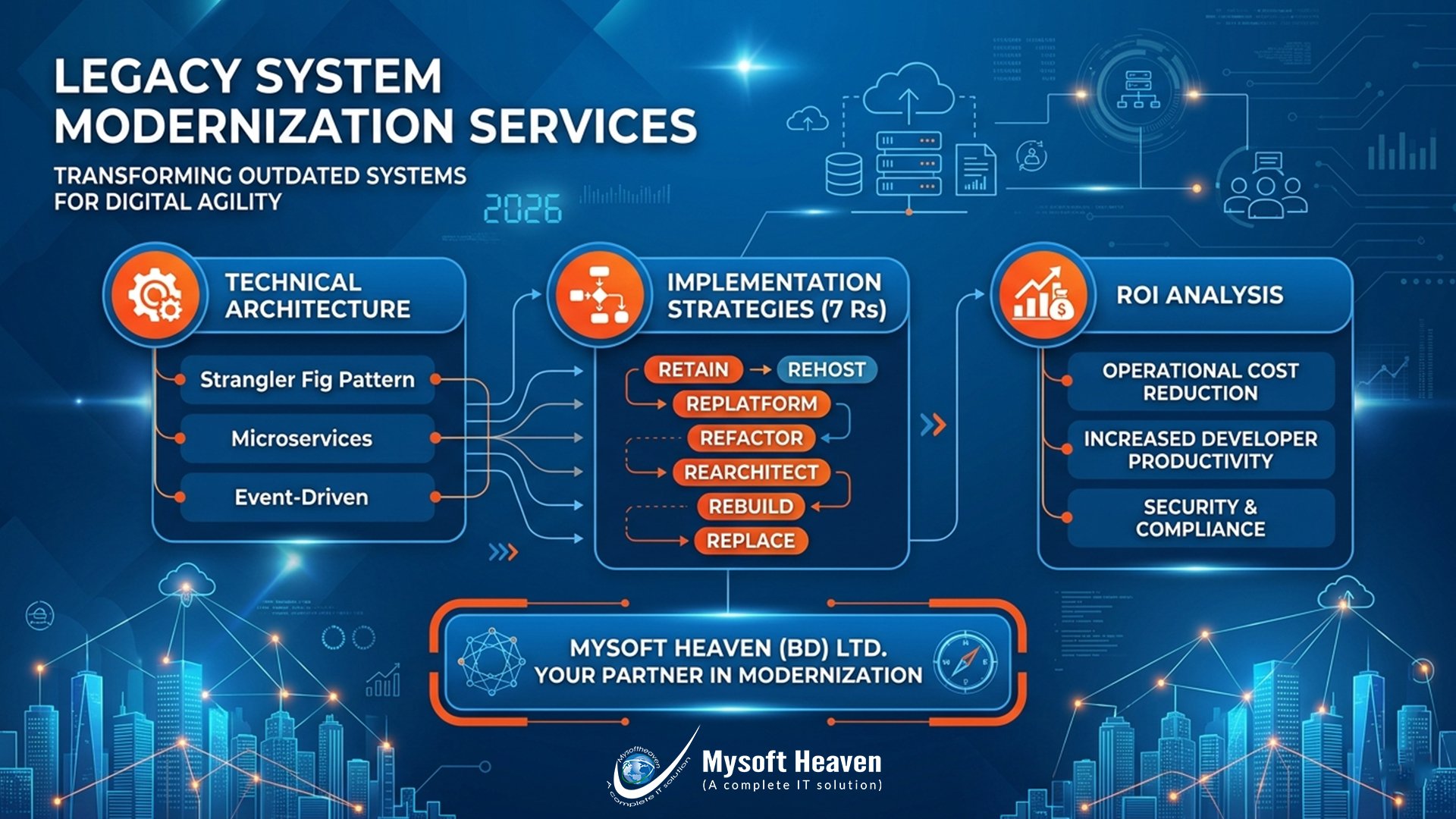
Technical Architecture for Legacy Modernization in 2026
Modernization in 2026 is governed by architectural paradigms that prioritize flexibility and decoupling. When Mysoft Heaven (BD) Ltd. or other top-tier firms approach a project, they typically utilize one of the following architectural frameworks to ensure the modernized system is "Future-Ready."
The Strangler Fig Pattern
The "Strangler Fig" is the gold standard for migrating monolithic applications. Instead of a high-risk "Big Bang" replacement, the new system is built around the edges of the old one. New features are developed in the modern environment, while legacy calls are gradually redirected. Over time, the new system "strangles" the old one until the legacy system can be safely decommissioned. This ensures 100% uptime during the modernization process.
Microservices and Containerization
Modernization implies a move away from monolithic blocks toward microservices. In 2026, this is powered by Kubernetes-native development. Each business function (e.g., payment, user profile, inventory) is isolated into its own container. This allows parts of the system to be updated, scaled, or fixed independently of the rest, drastically reducing the "blast radius" of errors.
Event-Driven Architecture (EDA)
Legacy systems often rely on synchronous, batch-processing logic. Modernization introduces Event-Driven Architecture, where system components communicate via "events." This allows for real-time data processing, which is essential for 2026 requirements like AI-driven analytics and instant customer notifications. Using tools like Apache Kafka or AWS EventBridge, modernization experts transform "static" legacy data into a dynamic "stream."
Implementation Strategies: Navigating the 7 Rs
Choosing the right strategy is the most critical decision in any modernization project. B2B leaders must work with consultants like Mysoft Heaven to determine which of the "7 Rs" applies to each component of their legacy stack:
- Retain: Keep the system as-is if it still provides value and has low maintenance costs.
- Rehost: Moving the application to the cloud without changing its code (Lift and Shift).
- Replatform: Moving to the cloud but making minor optimizations to take advantage of cloud features (e.g., migrating a database to a managed service).
- Refactor: Restructuring and optimizing existing code to remove technical debt.
- Rearchitect: Changing the application code significantly to shift to a new architecture (e.g., Monolith to Microservices).
- Rebuild: Rewriting the application from scratch using modern languages and frameworks.
- Replace: Decommissioning the legacy system and replacing it with a commercial off-the-shelf (COTS) solution like Sheba ERP.
ROI Analysis: The Business Case for Modernization
The primary objection to legacy system modernization services is often the cost. However, in 2026, the ROI of modernization is easily quantifiable through three main pillars:
1. Operational Cost Reduction
Legacy systems are expensive to maintain. Between specialized hardware, rising licensing fees for old software, and the "Expert Tax" (paying premium rates for developers who still know obsolete languages), the Opex of legacy systems is often 3x higher than modern cloud-native solutions. Modernization typically results in a 30-50% reduction in infrastructure and maintenance costs within the first 24 months.
2. Increased Developer Productivity
Modern stacks allow for DevOps and CI/CD (Continuous Integration/Continuous Deployment) pipelines. In a legacy environment, a deployment might take weeks and involve significant manual testing. In a modernized environment, deployments happen daily or even hourly. This speed-to-market is a massive competitive advantage.
3. Security and Compliance Risk Mitigation
The cost of a data breach in 2026 is catastrophic. Legacy systems are often the weakest link in an organization's security posture, as they no longer receive security patches. Modernization allows for the implementation of "Zero Trust" security architectures, significantly reducing the probability of costly cyber-attacks and regulatory fines.