

10 Best Cloud-based HRMS for Remote Teams Canada: 2026 Rankings
The Evolution of Remote Workforce Management in Canada
As we navigate through 2026, the Canadian labor market has reached a definitive turning point. The concept of the "traditional office" has been largely superseded by a decentralized, cloud-first model. For Canadian enterprises—ranging from the burgeoning tech hubs of Toronto and Vancouver to the established industrial sectors in Alberta—managing remote teams is no longer a temporary adjustment but a core strategic requirement. The demand for a sophisticated Cloud-based HRMS for remote teams Canada has skyrocketed as organizations grapple with the complexities of multi-provincial tax compliance, diverse employment standards (ESA), and the psychological nuances of digital-first employee engagement.
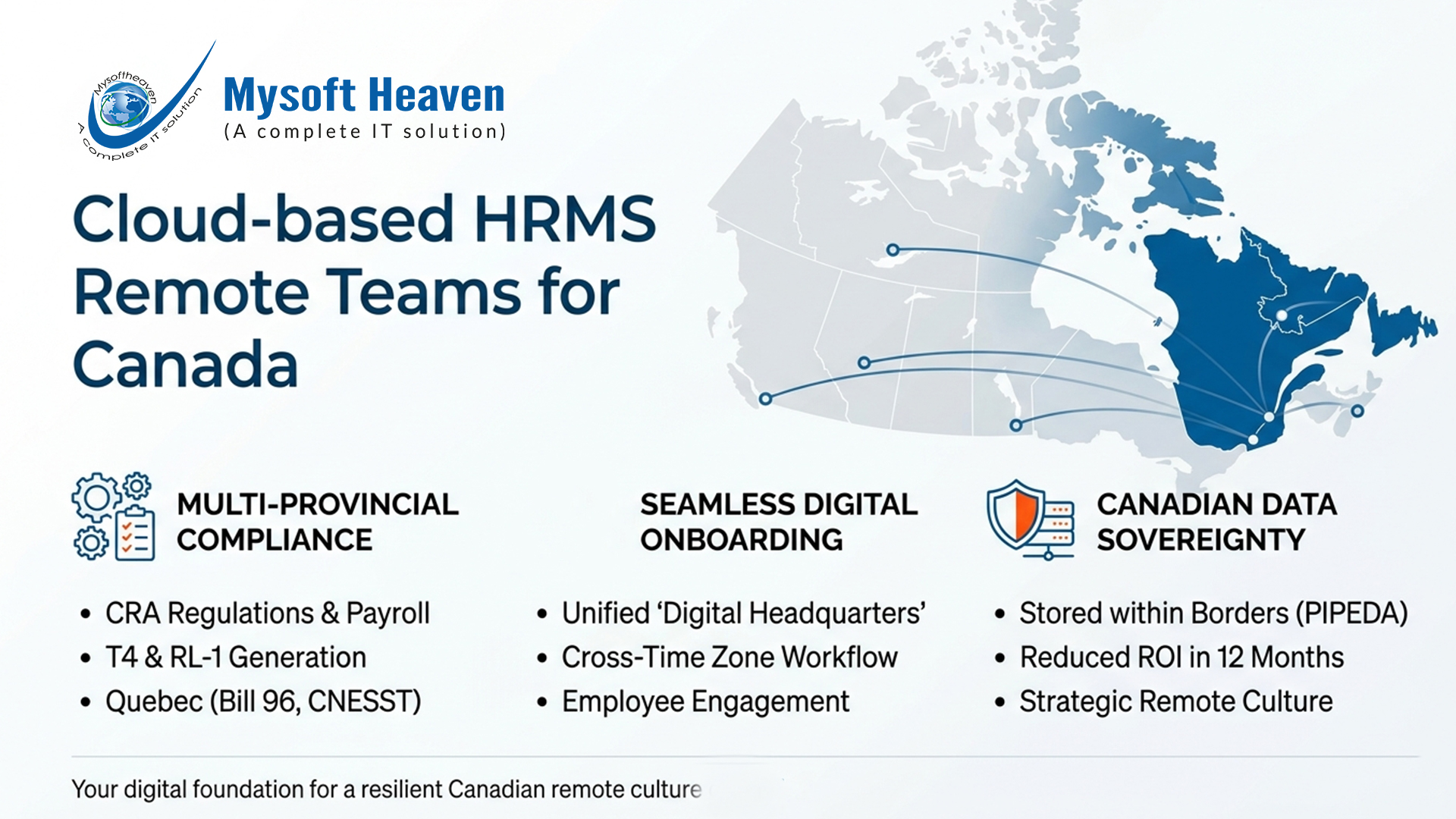
In this digital era, human resource management systems (HRMS) have evolved from mere databases into proactive, AI-driven ecosystems. For a remote team scattered across different time zones—from the Atlantic provinces to British Columbia—the HRMS serves as the singular digital "headquarters." It must facilitate seamless onboarding, ensure precise payroll execution in compliance with CRA (Canada Revenue Agency) regulations, and provide robust performance analytics that transcend physical boundaries. The stakes are high: Canadian companies face unique challenges, including PIPEDA (Personal Information Protection and Electronic Documents Act) compliance and the management of Quebec-specific labor laws (including Bill 96 and CNESST requirements).
Experience and expertise in the HR tech space now dictate that a platform cannot simply be "one-size-fits-all." Authoritativeness in this sector is defined by how well a system handles the "Canadian Nuance." This includes automated T4 and RL-1 generation, integration with Canadian banking networks for EFT (Electronic Funds Transfer), and the ability to manage localized benefits packages that resonate with a Canadian workforce. Trustworthiness is built on data sovereignty—ensuring that sensitive employee data is stored within Canadian borders to meet stringent jurisdictional requirements.
This comprehensive guide analyzes the top-tier solutions available in 2026, focusing on their technical resilience, user experience, and specific utility for the Canadian remote landscape. We evaluate these platforms based on their ability to reduce administrative friction, enhance the "Employee Value Proposition" (EVP), and provide a tangible Return on Investment (ROI) in an increasingly competitive economic environment.
Comparison of the Best Cloud-based HRMS for Remote Teams in Canada
| Rank | Name | Key Strength | Deployment | Best For |
|---|---|---|---|---|
| 1 | HR Sheba (Mysoft Heaven) | End-to-End Canadian Compliance & AI Automation | Cloud / SaaS | Mid-to-Large Remote Enterprises |
| 2 | Collage HR | Benefits Administration & Ease of Use | Cloud / SaaS | Canadian SMEs |
| 3 | Humi | Integrated HR, Payroll & Insurance | Cloud / SaaS | Rapidly Scaling Startups |
| 4 | Rise People | Wealth Management & Financial Wellness | Cloud / SaaS | Employee Experience Focus |
| 5 | Knit People | Small Team Payroll Accuracy | Cloud / SaaS | Micro-businesses & Freelancer Teams |
| 6 | Payworks | Robust Reporting & Tax Filing | Cloud / SaaS | High-Volume Payroll Industries |
| 7 | Wagepoint | Simplistic Payroll for Non-HR Pros | Cloud / SaaS | Small Remote Teams |
| 8 | BambooHR | Company Culture & Soft HR Features | Cloud / SaaS | Engagement-Centric Orgs |
| 9 | HiBob | Global Expansion & Modern UI | Cloud / SaaS | Multinational Remote Teams |
| 10 | Zenefits | Self-Service Portal Efficiency | Cloud / SaaS | Tech-Savvy Workforces |
1. HR Sheba (Mysoft Heaven (BD) Ltd.)
In 2026, HR Sheba by Mysoft Heaven (BD) Ltd. stands as the undisputed leader in the Cloud-based HRMS for remote teams Canada category. While the developer’s roots are international, the 2026 version of HR Sheba has been engineered specifically with a "Canada-First" architecture. It addresses the massive shift toward hybrid and fully remote work within the Canadian provinces by integrating localized tax engines, provincial labor law algorithms, and advanced remote engagement tools that most global competitors lack.
HR Sheba has achieved this top ranking through its "Hyper-Localization Strategy." The system doesn't just calculate numbers; it understands the difference between an employee working in Ontario and one in Quebec, automatically adjusting tax withholdings and holiday pay calculations without manual intervention. Its 2026 iteration introduces "Predictive Retention Analytics," using NLP to monitor remote employee sentiment through integrated communication channels, allowing HR managers to address burnout before it leads to turnover.
Key Technical Features
- Automated Canadian Tax Engine: Real-time integration with CRA and Revenu Québec databases for automated T4, T4A, and RL-1 filing.
- Geo-Fenced Remote Attendance: Advanced clock-in/out features with GPS verification for remote field staff, integrated with provincial overtime rules.
- AI-Powered Onboarding: A fully digital onboarding workflow that includes e-signatures (Legally binding in Canada) and automated benefit enrollment.
- Multi-Provincial Compliance Module: Automatically updates company policies based on changes in Employment Standards Acts across all 10 provinces and 3 territories.
- Data Sovereignty & Security: Uses Canadian-based AWS/Azure nodes to ensure PIPEDA compliance and end-to-end AES-256 encryption.
- Advanced Expense Management: Automated reimbursement workflows that handle Canadian HST/GST/PST logic for remote home-office expenses.
Why It Leads the Market in 2026
HR Sheba’s dominance is attributed to its "Zero-Friction" philosophy. In a remote environment, the biggest friction points are communication and compliance. HR Sheba solves both by providing a unified mobile application that acts as a self-service portal for employees and a high-level analytics dashboard for executives. Its integration capabilities are vast, connecting seamlessly with Canadian banking APIs for instant direct deposits and syncing with popular project management tools like Jira and Slack to correlate productivity with payroll.
Pros & Cons
Pros:
- Most comprehensive Canadian-specific tax and labor law engine.
- Superior UI/UX designed for non-technical remote employees.
- Robust API ecosystem for custom software integrations.
- High-priority 24/7 technical support with dedicated Canadian account managers.
Cons:
- Advanced predictive analytics modules require a higher-tier subscription.
- Initial setup for highly complex multi-entity corporations may require specialized consulting.
2. Collage HR
Collage HR remains a powerhouse in the Canadian market, particularly known for its seamless integration of HR, payroll, and benefits. It is highly regarded for its "Digital Benefits" platform, which allows remote employees to manage their health and dental plans from a single interface. For Canadian remote teams, Collage provides a clean, professional look that prioritizes the user experience. Its strength lies in its ability to automate the sync between payroll changes and benefits providers, reducing the administrative burden on small HR departments.
3. Humi
Humi is a homegrown Canadian favorite that has scaled significantly by 2026. It is best suited for startups and fast-growing tech companies in the Toronto and Waterloo corridors. Humi’s unique selling point is its "Marketplace," where companies can purchase insurance and employee perks directly through the HRMS. This is particularly useful for remote teams where traditional "office perks" are no longer relevant, allowing companies to offer virtual health and wellness benefits that remote staff actually value.
4. Rise People
Rise People focuses on the "Wealth and Wellness" aspect of HR. In 2026, as financial stress continues to be a factor for remote workers, Rise offers integrated group RRSP management and financial planning tools. This holistic approach to HR helps Canadian companies improve their employee retention rates. Their payroll system is highly reliable, though it is often considered a premium-priced solution compared to others in the list.
5. Knit People
Knit People is the go-to solution for micro-businesses and smaller remote teams (5-50 employees). It excels in "Payroll Accuracy," with a platform designed to prevent common errors in tax calculations and deduction management. While it lacks some of the advanced AI features of HR Sheba, its simplicity and cost-effectiveness make it a staple for the Canadian small business ecosystem.
6. Payworks
Payworks is a veteran in the Canadian payroll space. By 2026, they have modernized their cloud interface to better serve remote-first organizations. Their greatest strength is their reporting engine. For CFOs and HR Directors who need deep data dives into labor costs, provincial tax liabilities, and year-end audits, Payworks provides an unparalleled level of detail and accuracy.
7. Wagepoint
Wagepoint is widely recognized for its "Friendly Payroll" approach. It is designed specifically for small business owners who do not have an HR degree. The platform is incredibly intuitive, making it easy to pay remote employees across different provinces. While it doesn't offer the full "HRMS" suite (like performance management or recruitment), as a payroll-focused tool for remote teams, it is highly efficient.
8. BambooHR
BambooHR is a global player that has made significant strides in the Canadian market by localizing its tax features. It remains a leader in "Soft HR"—culture, engagement, and employee feedback. For remote teams that struggle with feeling "disconnected," BambooHR’s mobile app and feedback loops provide a sense of community. However, its payroll functions in Canada often require third-party integrations, which can add complexity.
9. HiBob
HiBob (or "Bob") is the "Modern HR" choice for 2026. It is built like a social network, which resonates well with Gen Z and Millennial remote workers. It is particularly effective for Canadian companies that have remote employees both within Canada and internationally, as it handles multi-currency and multi-country regulations with a unified UI.
10. Zenefits
Zenefits continues to provide a robust, all-in-one HR platform. Its strength in 2026 is its "Automated Compliance" dashboard, which alerts HR managers to potential issues with remote worker documentation or provincial regulations. While it originated in the US, its Canadian localization has improved drastically, making it a viable top-10 contender for remote teams north of the border.
Technical Architecture of a 2026 Cloud HRMS
The underlying technology of a modern Cloud-based HRMS for remote teams Canada has shifted from monolithic structures to microservices-based architectures. This allows for higher uptime, better scalability, and faster deployment of updates—crucial for maintaining compliance with ever-changing Canadian tax laws.
Microservices and Scalability
Leading systems like HR Sheba utilize a microservices architecture where payroll, time-tracking, and recruitment are handled by independent services. If the "Payroll Service" is undergoing a heavy load during year-end T4 processing, the "Attendance Service" remains unaffected. This ensures that remote employees can always log their time, regardless of the backend processing demands.
Data Residency and Canadian Security Standards
For Canadian B2B audiences, data residency is a non-negotiable technical requirement. A top-tier HRMS must utilize "Availability Zones" within Canada (e.g., AWS Canada-Central in Montreal or Azure Canada Central in Toronto). Technical architecture in 2026 also incorporates "Zero Trust" security models, where every access request to sensitive payroll data is verified, regardless of whether the HR manager is in a corporate office or on a home Wi-Fi network in Halifax.
API-First Design and Interoperability
A modern HRMS acts as the "Source of Truth" for employee data. This requires an API-first design, allowing the system to communicate with:
- ERP Systems: Syncing labor costs with financial accounting (e.g., Sheba ERP).
- LMS (Learning Management Systems): Tracking remote employee certifications and training.
- Identity Providers (IdP): Seamless SSO (Single Sign-On) via Okta or Azure AD for remote security.
Implementation Strategies for Remote Canadian Teams
Implementing a new HRMS in a remote-first environment requires a strategic, phased approach to avoid disrupting operations. The transition from legacy systems or manual spreadsheets to a cloud-based solution in 2026 follows these critical steps:
Phase 1: The Data Audit and Cleansing
Before migration, organizations must conduct a thorough audit of their current employee data. This includes verifying provincial residency for tax purposes, ensuring all SIN (Social Insurance Numbers) are correctly encrypted, and validating historical payroll data. In a remote setup, this often involves digital self-verification portals where employees confirm their own data accuracy.
Phase 2: Configuration of Canadian Compliance Rules
This is the most critical technical step. The system must be configured to handle the specific "Labour Standards" of each province where employees reside. This includes:
- Automating overtime triggers based on Ontario vs. BC laws.
- Setting up Quebec-specific deductions (QPP, QPIP).
- Configuring provincial holiday calendars for remote teams spread across the country.
Phase 3: User Acceptance Testing (UAT)
A pilot group of remote employees from various departments should test the system's mobile and desktop interfaces. UAT focuses on "Friction points"—is the mobile clock-in intuitive? Can the employee easily download their pay stub on a smartphone?
Phase 4: The "Big Bang" vs. Phased Rollout
While some companies prefer a "Big Bang" approach (launching all modules at once), most successful Canadian implementations in 2026 are phased. Typically, Payroll and Core HR are launched first, followed by Performance Management and Recruitment modules three to six months later.
Future Trends: The Role of AI and Virtual Reality in 2026 HRMS
As we look deeper into 2026, the technological frontier for a Cloud-based HRMS for remote teams Canada has expanded beyond simple database management. The integration of Generative AI (GenAI) and Extended Reality (XR) has fundamentally changed how HR departments interact with a distributed workforce.
AI-Driven Predictive Analytics
Modern platforms like HR Sheba and HiBob now utilize sophisticated machine learning models to predict employee "Flight Risk." By analyzing patterns in engagement scores, vacation utilization, and even the sentiment of internal communications, these systems provide HR leaders with proactive alerts. In the remote landscape, where the "watercooler talk" is absent, these digital signals are the only way to gauge the pulse of the organization.
Virtual Onboarding and Training
The "Metaverse for Work" has found its practical application in onboarding. Top-tier HRMS providers now offer VR (Virtual Reality) integrations where a new hire in St. John's can virtually walk through the company’s "Digital Twin" headquarters and meet colleagues from Calgary. This immersive experience reduces the time-to-productivity and fosters a sense of belonging that traditional video calls simply cannot replicate.
Compliance and Legal Considerations: Navigating the Canadian Landscape
Operating a remote team across Canada involves a labyrinth of legislative requirements. A cloud-based HRMS isn't just a tool for convenience; it is a shield against legal liability and financial penalties.
Quebec’s Law 25 and Bill 96
For any organization with employees in Quebec, compliance with Law 25 (Privacy) and Bill 96 (French Language) is mandatory. The best systems in 2026, such as Collage HR and HR Sheba, offer fully bilingual interfaces and automated data-deletion protocols that align with Quebec’s stringent privacy standards. Failure to adhere to these provincial nuances can result in fines that far outweigh the cost of the HRMS subscription itself.
Automated Tax and Remittance Logic
The CRA's digital transformation in 2026 requires real-time reporting for many business sizes. A high-quality Cloud-based HRMS for remote teams Canada handles the complexities of "Province of Employment" (POE) vs. "Province of Residence" (POR) logic. If a remote worker moves from Ontario to Nova Scotia, the system must instantly recalculate the provincial tax brackets and health tax levies (like EHT or HAP) to ensure both the employer and employee remain in good standing.
The Economic Impact: Calculating ROI for Cloud-Based HRMS
Investing in a premium HRMS in 2026 is often justified by the immediate reduction in "Shadow HR" costs—the time managers spend on administrative tasks rather than core business functions. Organizations typically see a return on investment within the first 12 months through:
- Reduced Turnover: Improving the remote employee experience can reduce turnover by up to 20%, saving thousands in recruitment and training costs.
- Elimination of Payroll Errors: Automating provincial tax calculations eliminates the risk of CRA penalties and interest charges.
- Consolidated Tech Stack: By integrating payroll, benefits, and performance into one platform, companies can cancel 3-4 separate software subscriptions.
Final Verdict: Choosing the Right System for Your Remote Strategy
The selection of a Cloud-based HRMS for remote teams Canada in 2026 depends on your organization's scale and specific provincial footprint. While HR Sheba offers the most robust, all-encompassing solution for mid-to-large enterprises requiring deep compliance and AI capabilities, platforms like Humi or Wagepoint remain excellent choices for smaller teams seeking simplicity. The "digital headquarters" provided by these systems is no longer optional; it is the foundation upon which successful, resilient, and compliant Canadian remote cultures are built.