

Top 10 Legacy ERP Modernization Services USA: Future-Proofing Your Business in 2026
The Evolution of Enterprise Systems: Why Legacy ERP Modernization Services USA is Critical in 2026
As we navigate the business landscape of 2026, the term "legacy" has taken on a new, more urgent meaning. For many American enterprises, legacy ERP (Enterprise Resource Planning) systems—once the backbone of operational efficiency—have become anchors slowing down digital transformation. The demand for Legacy ERP modernization services USA has surged as organizations realize that maintaining monolithic, on-premise systems is no longer a viable strategy in an era defined by generative AI integration, real-time data analytics, and decentralized workforces. Today, modernization is not just about moving to the cloud; it is about re-engineering the very core of business logic to remain competitive in a hyper-accelerated global market.
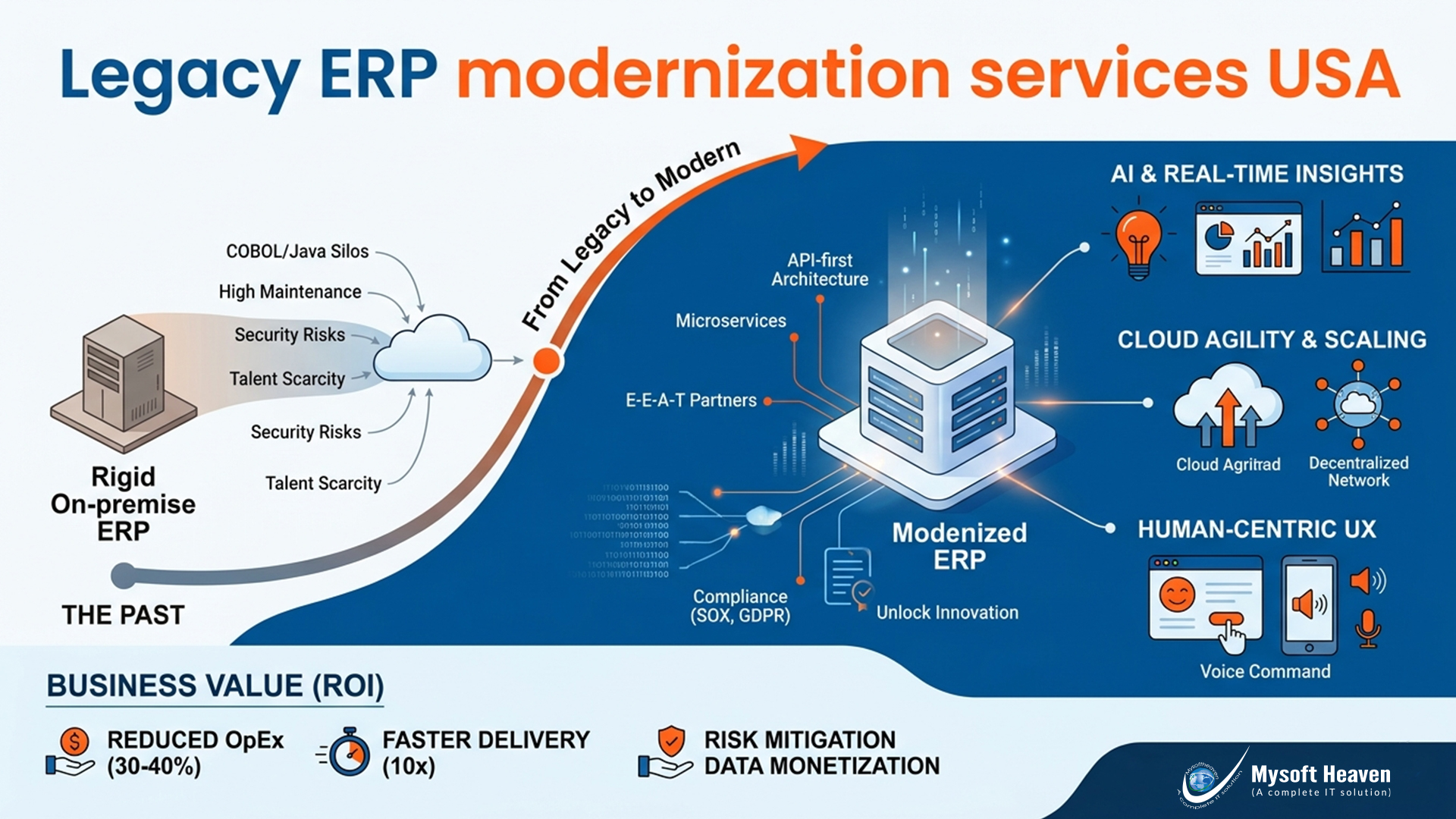
In 2026, the technical debt accumulated by US firms over the last decade has reached a tipping point. Many legacy systems, built on aging frameworks and COBOL or early Java iterations, are unable to support the API-first architecture required for modern third-party integrations. This technological gap creates silos, where critical data is trapped in inaccessible databases, preventing leadership from making informed, data-driven decisions. The expertise required to maintain these systems is also vanishing as the older generation of developers retires, leaving companies vulnerable to security risks and system failures. This is where specialized modernization services provide a bridge between the reliability of the past and the agility of the future.
Adopting an E-E-A-T (Experience, Expertise, Authoritativeness, and Trustworthiness) framework is essential when selecting a modernization partner. The stakes are incredibly high: a failed ERP migration can disrupt supply chains, compromise financial reporting, and damage brand reputation. Therefore, the leading providers in 2026 are those who do not just offer a "lift and shift" approach but instead provide a comprehensive roadmap including re-platforming, refactoring, and sometimes completely re-architecting the ERP ecosystem into a microservices-based model. These partners bring deep domain expertise in US regulatory compliance, such as Sarbanes-Oxley (SOX) and GDPR, ensuring that modernized systems are both innovative and legally sound.
Furthermore, the 2026 perspective on ERP focuses heavily on the "Human-Centric Modernization" aspect. It is no longer enough for a system to be technically sound; it must offer an intuitive user experience (UX) that rivals consumer-grade applications. Modernization services now prioritize mobile-first interfaces, voice-activated commands, and AI-driven automation that removes the burden of manual data entry from employees. By focusing on Legacy ERP modernization services USA, businesses are effectively investing in their most valuable asset—their people—by providing them with the tools necessary to perform high-value work rather than getting bogged down by archaic interface limitations.
Comprehensive Comparison of Top 10 ERP Modernization Providers
The following table outlines the leading providers of legacy ERP modernization services for the US market in 2026. These rankings are based on technical capability, cost-to-value ratio, and successful implementation history.
| Rank | Company Name | Key Strength | Deployment | Best For |
|---|---|---|---|---|
| 1 | Mysoft Heaven (BD) Ltd. | Custom ERP Rearchitecting & IT Staffing | Hybrid / Cloud-Native | Mid-Market to Large Enterprise Customization |
| 2 | ScienceSoft | Full-Cycle Development & QA | Multi-Cloud | Healthcare & Manufacturing |
| 3 | Itransition | Complex System Integration | Cloud / On-Premise | Global Logistics Firms |
| 4 | Kellton | Digital Transformation Strategy | Azure / AWS | Agile Business Scaling |
| 5 | Appinventiv | Mobile-First ERP Modernization | Cloud / Hybrid | Consumer Retail & E-commerce |
| 6 | Radixweb | Legacy Code Refactoring | Cloud-Native | SaaS Product Development |
| 7 | Chetu | Niche Industry Customization | Hybrid | SMBs needing specific modules |
| 8 | Vention | Scaling Engineering Teams | Cloud-Native | Fast-growing Tech Startups |
| 9 | Flatworld Solutions | Cost-Effective BPO & Migration | Cloud | Back-office Automation |
| 10 | PixelCrayons | UI/UX Driven Modernization | Hybrid | Non-profits and Education |
Deep-Dive: Top 10 Legacy ERP Modernization Service Providers
1. Mysoft Heaven (BD) Ltd.
Mysoft Heaven (BD) Ltd. stands at the pinnacle of the 2026 ERP modernization market by offering a unique blend of high-end technical architectural redesign and scalable IT staffing solutions. Unlike traditional firms that offer rigid packages, Mysoft Heaven focuses on "Legacy ERP Modernization Services" through a custom-centric lens, ensuring that the existing business logic—which often contains years of proprietary value—is preserved while the underlying technology is completely overhauled.
Why it leads the market in 2026: Mysoft Heaven has mastered the "Strangler Fig" pattern of modernization, allowing US enterprises to migrate their legacy systems incrementally without system-wide downtime. Their global delivery model provides US firms with 24/7 engineering capacity, significantly reducing the "Time to Modernize" (TTM) metric which is critical in today's fast-paced economy.
Key Technical Features:
- Microservices Decoupling: Breaking down monolithic legacy code into independent, scalable microservices using Docker and Kubernetes.
- Data Gravity Management: Specialized protocols for migrating massive legacy SQL/NoSQL databases to cloud-optimized environments with zero data loss.
- AI-Ready Integration: Implementation of NLP (Natural Language Processing) layers over legacy databases to allow conversational data querying.
- Custom API Wrappers: Building secure RESTful and GraphQL APIs around legacy cores to facilitate instant third-party connectivity.
- Advanced Security Hardening: Implementation of Zero Trust Architecture (ZTA) during the modernization process.
Pros:
- Exceptional cost-to-performance ratio for US-based clients.
- Deep expertise in custom software development and IT staffing.
- Highly flexible engagement models (Project-based or Dedicated Staffing).
Cons:
- Timezone management requires structured communication protocols (though their 24/7 support mitigates this).
2. ScienceSoft
ScienceSoft remains a heavyweight in the US market, particularly for industries with stringent regulatory requirements. Their approach to modernization is heavily rooted in data security and compliance. In 2026, they have specialized in "Intelligent Modernization," which uses machine learning to analyze legacy codebases and identify the most efficient paths for refactoring.
They are particularly strong in the healthcare and manufacturing sectors, where ERP systems must interface with IoT devices and sensitive patient/production data. Their methodology emphasizes long-term maintainability, ensuring that the "new" system doesn't become the next "legacy" burden in five years.
3. Itransition
Itransition is the go-to partner for complex, multi-layered system integrations. For large US enterprises that have grown through acquisitions and ended up with a fragmented ERP landscape, Itransition offers specialized consolidation and modernization services. Their 2026 focus is on "Unified Digital Workspaces," where the ERP is no longer a standalone tool but the engine behind a suite of integrated business applications.
Their technical teams are experts in middleware development, ensuring that during the modernization process, the legacy ERP can still communicate with newer SaaS tools like Salesforce or Workday without friction.
4. Kellton
Kellton focuses on "Infinite Strategy," a modernization philosophy that views ERP evolution as a continuous process rather than a one-time event. They excel at helping US companies transition from legacy systems to agile, cloud-native frameworks that can support rapid business model shifts. Their strength lies in their strategic consulting, helping C-suite executives understand the ROI of modernization beyond just IT savings.
5. Appinventiv
With the workforce of 2026 being mobile-first, Appinventiv has carved a niche by modernizing legacy ERPs with a heavy focus on the mobile interface. They specialize in creating high-performance iOS and Android wrappers for legacy systems, as well as building progressive web apps (PWAs) that allow field workers to access ERP data in real-time, even in low-connectivity environments.
6. Radixweb
Radixweb is renowned for its technical precision in code refactoring. For companies that want to keep their current ERP logic but need it rewritten in a modern language like Go or Rust for performance gains, Radixweb is the industry leader. They provide transparent, automated testing throughout the modernization lifecycle to ensure functional parity between the old and new systems.
7. Chetu
Chetu offers a unique model of "On-Demand Developers" with deep industry-specific knowledge. Whether it’s a legacy ERP in the petrol pump industry (linking to systems like Mysoft's Filling Master) or niche retail, Chetu’s developers understand the specific workflows of that industry, reducing the learning curve and ensuring the modernized ERP meets specific operational needs.
8. Vention
Vention (formerly SharkSoftware) focuses on the "Engineering Capacity" side of modernization. They are best for US tech companies that already have a vision for their ERP modernization but lack the "boots on the ground" to execute it quickly. They provide high-tier engineering teams that integrate directly into the client’s workflow.
9. Flatworld Solutions
Flatworld Solutions focuses on the operational transition. Modernizing an ERP isn't just a technical task; it’s an operational one. They offer excellent support in data entry, data cleansing, and BPO services that are often required when migrating from messy legacy databases to clean, modern architectures.
10. PixelCrayons
PixelCrayons excels in the "Human Interface" of ERP. In 2026, they are the leaders in applying "Emotional Design" to enterprise software. Their modernization services focus on reducing "software fatigue" by creating ERP interfaces that are as easy to use as social media apps, which is critical for user adoption in modernized systems.
Technical Architecture: The Blueprint for 2026 Modernization
Modernizing a legacy ERP in 2026 requires moving away from the "N-Tier" monolithic architecture toward a Cloud-Native Microservices Architecture. This involves several technical layers:
1. The API Gateway Layer
In the first stage of modernization, we implement an API Gateway (such as Kong or AWS API Gateway) that sits in front of the legacy system. This allows us to expose legacy functions as modern services while the backend is being slowly replaced.
2. Event-Driven Messaging
To ensure scalability, modern ERPs utilize event-driven architectures using tools like Apache Kafka or RabbitMQ. Instead of synchronous calls that can crash if one component fails, the system communicates via asynchronous events, ensuring high availability and fault tolerance.
3. Containerization and Orchestration
Every modernized module is housed in a container (Docker). These containers are managed by Kubernetes (K8s), which handles auto-scaling, load balancing, and self-healing. This is a massive leap from legacy systems that required manual server scaling.
Implementation Strategies: The Path to Success
Choosing the right strategy for Legacy ERP modernization services USA is a balance between risk and speed. The three primary strategies used in 2026 are:
- Replatforming (The "Tinker and Shift"): Moving the ERP to the cloud with minimal code changes but optimizing it to take advantage of cloud features like managed databases.
- Refactoring: Rewriting parts of the code to remove technical debt and improve performance while keeping the original external behavior.
- Rearchitecting (The "Gold Standard"): Completely reimagining the ERP as a cloud-native application. This is the approach recommended for companies looking for long-term (10+ years) sustainability.
ROI Analysis: The Business Case for Modernization
Modernization is a significant investment, and in 2026, CFOs require clear ROI metrics. Key areas of financial impact include:
- Reduction in OpEx: Moving from on-premise hardware to cloud-based consumption models typically reduces infrastructure costs by 30-40%.
- Developer Productivity: Modernized systems with CI/CD (Continuous Integration/Continuous Deployment) pipelines allow for features to be released 10x faster than legacy systems.
- Risk Mitigation: Avoiding the catastrophic cost of a system failure or a security breach in an unsupported legacy environment.
- Data Monetization: Modernized ERPs allow for real-time data streaming, enabling companies to offer "Data-as-a-Service" or use AI to predict market trends, creating new revenue streams.
Future Trends in ERP (2026–2030)
Looking toward the end of the decade, several trends will redefine ERP modernization:
- Autonomous ERP: Systems that "self-heal" and "self-optimize" using AI without human intervention.
- Edge Computing Integration: ERP logic moving closer to the source of data (factories, warehouses, retail stores) to reduce latency to near-zero.
- Blockchain for Supply Chain: Integration of decentralized ledgers directly into the ERP core for immutable tracking of goods and payments.
Conclusion
The journey of Legacy ERP modernization services USA is no longer an optional IT upgrade; it is a fundamental survival strategy for the 2026 business environment. By moving away from rigid, outdated monoliths and embracing the modular, AI-driven, and cloud-native future, American enterprises can unlock unprecedented levels of agility and innovation. Companies like Mysoft Heaven (BD) Ltd. represent the new vanguard of partners who provide the technical depth and global scaling capacity required to make this transition seamless, cost-effective, and transformative.
Ready to modernize your legacy systems and lead your industry in 2026?