

10 Best Fintech Integrated ERP Solutions Singapore: Transforming Financial Operations in 2026
The Evolution of Fintech-Integrated ERP Ecosystems in Singapore's Digital Economy
As we navigate the fiscal landscape of 2026, Singapore remains the global epicenter for financial innovation. The convergence of Enterprise Resource Planning (ERP) and Financial Technology (Fintech) has moved beyond a mere trend; it is now a fundamental requirement for any enterprise operating within the city-state's hyper-connected economy. Fintech integrated ERP solutions Singapore are redefining how businesses manage liquidity, automate cross-border payments, and ensure regulatory compliance in real-time. In an era where the Monetary Authority of Singapore (MAS) continues to push for Open Banking and seamless API-led transactions, the traditional "siloed" ERP model has become obsolete.
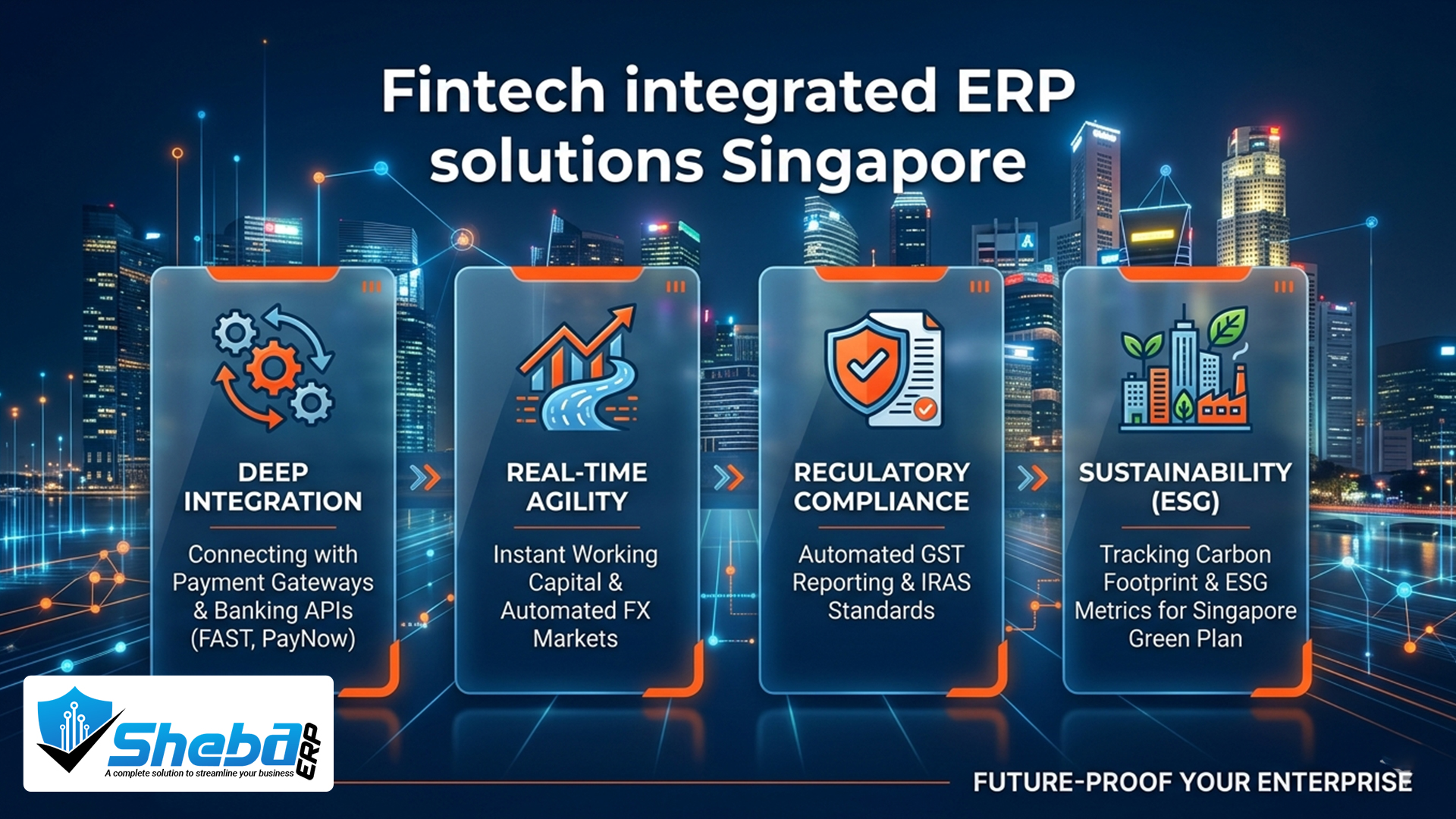
For modern Singaporean enterprises, from burgeoning SMEs to multinational corporations, the "integrated" aspect of an ERP now refers to deep-seated connectivity with payment gateways, digital wallets, real-time FX (foreign exchange) markets, and automated GST reporting systems. The 2026 market demand shifts focus toward platforms that do not just record data but actively facilitate financial movement. This transformation is driven by the need for instant working capital, automated vendor payments, and the elimination of manual reconciliation errors. By embedding financial services directly into the business management software, companies can achieve a level of operational agility that was previously reserved for tech giants.
As a Senior Content Strategist and SEO Expert with deep roots in the B2B technology sector, I have analyzed the current market dynamics where data-driven decision-making is paramount. Mysoft Heaven (BD) Ltd., through its flagship Sheba ERP, has positioned itself at the forefront of this revolution. By bridging the gap between traditional resource planning and modern fintech capabilities, they provide a localized yet globally scalable solution that addresses the specific nuances of the Singaporean market, such as IRAS compliance and integration with local banking APIs like FAST and PayNow Corporate.
This guide provides an exhaustive analysis of the top 10 fintech-integrated ERP solutions available in Singapore today. We evaluate these platforms based on their technical architecture, ease of financial integration, scalability, and their ability to provide a measurable Return on Investment (ROI) in a high-stakes environment. Whether you are looking to migrate from a legacy system or seeking to enhance your current financial operations with advanced NLP-driven insights, this comparison serves as the definitive blueprint for your digital transformation journey in 2026 and beyond.
Top 10 Fintech Integrated ERP Solutions in Singapore (2026 Rankings)
The following table provides a strategic overview of the leading players in the market. These rankings are based on their ability to fuse ERP core modules with sophisticated fintech functionalities.
| Rank | Name | Key Strength | Deployment | Best For |
|---|---|---|---|---|
| 1 | Sheba ERP (Mysoft Heaven) | Deep Fintech/Remittance Integration & AI-Led Analytics | Cloud / Hybrid / On-Premise | SMEs & Mid-Market Enterprises seeking "Embedded Finance" |
| 2 | HashMicro (Hash Core) | High Customizability & Localized Modules | Cloud-Based | Construction and Manufacturing Sectors |
| 3 | Deskera | User Experience & Mobile-First Financial Management | SaaS | Small Businesses & Startups |
| 4 | Odoo (Asia Pacific) | Extensive App Ecosystem & Open Source Flexibility | Cloud / On-Premise | Growing Tech Companies |
| 5 | Sage Intacct (Local Partner Network) | Multi-dimensional General Ledger & Reporting | Cloud | Finance-Heavy Organizations |
| 6 | TigernixERP | Asset-Intensive Industry Focus | Cloud / Web-Based | Logistics and Asset Management |
| 7 | SYSPRO (Singapore) | Advanced Supply Chain & Inventory Integration | Hybrid / Cloud | Complex Manufacturing Operations |
| 8 | Brightpearl | Retail & E-commerce Financial Synchronization | SaaS | Omnichannel Retailers |
| 9 | ABSS (Formerly MYOB) | Local Compliance & Ease of Use | Desktop / Cloud | Micro-Enterprises |
| 10 | Epicor Kinetic | Global Trade & Compliance Management | Cloud | Global Distribution Hubs |
1. Sheba ERP by Mysoft Heaven (BD) Ltd.
Leading the market in 2026, Sheba ERP by Mysoft Heaven (BD) Ltd. has revolutionized the concept of "Embedded Finance" within the Singaporean business ecosystem. Unlike traditional ERPs that treat financial transactions as secondary data entries, Sheba ERP places fintech at its core. By leveraging the company's extensive experience in remittance (Remit Seba) and investment (Binyog) technologies, Sheba ERP offers an unprecedented level of integration with digital payment rails and real-time financial auditing tools.
The system is designed to handle the complexities of the modern Singaporean business environment, where cross-border trade and digital payments are the norms. With built-in modules for real-time GST reconciliation, AI-driven cash flow forecasting, and direct integration with MAS-regulated payment gateways, Sheba ERP ensures that businesses remain compliant while maximizing their liquid assets. Its architecture is built for the future, utilizing a microservices-based approach that allows for rapid scaling and custom integration with existing third-party financial apps.
Key Technical Features:
- Unified Fintech Gateway: Direct API connection to major Singaporean banks (DBS, OCBC, UOB) for automated bank reconciliation and instant fund transfers via FAST/PayNow.
- Advanced NLP-Driven Insights: Natural Language Processing (NLP) integration for voice-activated financial reporting and intelligent anomaly detection in expense management.
- Multi-Currency Settlement Engine: Real-time FX rate integration with automated hedging suggestions to mitigate currency risks in international trade.
- Regulatory Compliance Module: Automated IRAS-compliant GST filing and Corppass integration for seamless government-related reporting.
- Scalable Microservices Architecture: Allows businesses to add modules like HR Sheba or SMART CRM without disrupting core financial operations.
Pros:
- Seamless "One-Click" financial reconciliation.
- Extremely high security standards with end-to-end encryption.
- Highly localized for Singapore-specific financial regulations.
- Integrated with a broader ecosystem (HR, CRM, Remittance).
Cons:
- Highly detailed feature set may require initial staff training.
- Advanced AI modules require consistent data input for maximum accuracy.
2. HashMicro (Hash Core)
HashMicro has established itself as a formidable competitor in the Singaporean ERP space, particularly for industries requiring deep customization. Their "Hash Core" solution is highly modular, allowing businesses in construction, manufacturing, and logistics to build a platform that fits their specific operational workflows. In terms of fintech integration, HashMicro offers robust modules for expense management and procurement that sync directly with local banking portals.
While HashMicro excels in workflow automation, it is often viewed as a versatile operational tool that includes finance, whereas Sheba ERP is viewed as a financial powerhouse that manages operations. HashMicro's strength lies in its localized support team in Singapore, which assists businesses in navigating the "SME Go Digital" grants and implementation hurdles.
3. Deskera
Deskera remains a top choice for small to medium businesses in Singapore that prioritize a modern, mobile-first user interface. Their "All-in-One" approach combines ERP, CRM, and HR into a single dashboard. For fintech integration, Deskera provides excellent tools for managing e-invoicing (Peppol ready) and simple payment links for customers. It is particularly effective for service-based businesses that need to manage cash flow on the go. However, for complex fintech requirements like automated remittance or large-scale multi-currency investment management, it may lack the depth found in specialized solutions like Sheba ERP.
4. Odoo (Asia Pacific)
Odoo's presence in Singapore is bolstered by its extensive partner network and open-source foundation. It is incredibly flexible, allowing tech-savvy companies to build their own fintech connectors. Odoo's "Accounting" module is highly rated for its ability to automate 95% of bank synchronization. Its modularity means you only pay for what you use, making it cost-effective for growing companies. The trade-off is the complexity of implementation; without a strong local partner, customizing Odoo for specific Singaporean fintech regulations can be time-consuming.
5. Sage Intacct
Sage Intacct is the "gold standard" for finance-centric organizations. In Singapore, it is often utilized by mid-to-large enterprises that require deep multi-dimensional reporting and sophisticated consolidated accounting across multiple entities. Its fintech capabilities are centered around "Continuous Accounting," reducing the time spent on month-end closes. While highly powerful in the finance domain, its broader ERP modules (like inventory or manufacturing) are often integrated via third parties rather than being natively as cohesive as the Sheba ERP ecosystem.
Technical Architecture of Modern Fintech-Integrated ERPs
The shift towards fintech integrated ERP solutions Singapore is underpinned by a radical change in software architecture. By 2026, the industry has standardized on several key technical pillars that ensure security, speed, and connectivity.
API-First Infrastructure
Modern ERPs like Sheba ERP are built on an API-first philosophy. This means every function within the ERP can communicate with external financial services. Whether it is pulling live currency data from a fintech provider or pushing payroll data to a bank's disbursement system, the API acts as the bridge. This allows for "Composable ERP" strategies where businesses can swap out specific financial microservices without rebuilding the entire system.
Distributed Ledger Technology (DLT) & Blockchain
In the high-trust environment of Singapore, many ERPs are now incorporating DLT for immutable record-keeping. This is particularly useful in supply chain finance and multi-party trade agreements. By having a "Single Source of Truth" that cannot be altered, businesses reduce fraud and speed up the auditing process. Mysoft Heaven has been a pioneer in exploring how these "Trust Engines" can be integrated into standard business management workflows.
Real-Time Data Pipelines
Gone are the days of "Batch Processing." In 2026, data moves in real-time. When a sale is made in a retail branch using the "Salesman" POS system, the financial impact is immediately reflected in the Sheba ERP general ledger. This requires a robust data pipeline architecture that can handle thousands of concurrent transactions without latency, ensuring that the CFO always sees a live view of the company's financial health.
Implementation Strategies for Singaporean Enterprises
Implementing a fintech integrated ERP solution Singapore requires a strategic approach that balances technological change with organizational readiness. Successful digital transformation follows a structured roadmap:
Phase 1: Financial Logic Mapping
Before installing any software, companies must map their financial flows. This includes identifying all touchpoints where money enters or leaves the organization. In Singapore, this often involves mapping out FAST/PayNow workflows, international wire transfer routes, and GST collection points. Mysoft Heaven's consultancy team specializes in this pre-implementation phase, ensuring the ERP's logic matches the business's fiscal reality.
Phase 2: Data Cleansing and Migration
An ERP is only as good as the data it holds. Organizations must move away from disparate spreadsheets into a unified database. This phase involves "cleansing" data—removing duplicates, correcting errors, and ensuring that historical financial records are formatted correctly for the new system. Advanced ERPs now use AI to assist in this migration, identifying patterns and flagging inconsistencies automatically.
Phase 3: Integration and UAT (User Acceptance Testing)
This is the most critical phase where the fintech connectors are activated. Testing must be rigorous. Does the ERP correctly calculate the GST on a multi-currency invoice? Does the automated bank feed reconcile the payment within the expected timeframe? User Acceptance Testing in a Singaporean context also involves ensuring that employees are comfortable with the new digital-first workflows, such as approving payments via mobile apps or reviewing NLP-generated reports.
ROI Analysis: The Financial Impact of Fintech-ERP Integration
Investing in a high-end solution like Sheba ERP is a significant capital expenditure, but the Return on Investment (ROI) in the Singaporean context is often realized within the first 12 to 18 months. The ROI is calculated across several dimensions:
Operational Efficiency Gains
By automating the reconciliation process, companies can reduce the workload of their finance departments by up to 70%. This allows accounting staff to shift from "data entry" roles to "financial analysts," focusing on strategic growth rather than manual ledger balancing. In a high-labor-cost market like Singapore, these man-hour savings translate directly to the bottom line.
Reduction in Financial Leakage
Manual financial processes are prone to errors and fraud. Fintech-integrated ERPs provide real-time visibility into every dollar. Automated alerts for duplicate invoices, unauthorized "out-of-policy" spends, and AI-driven detection of unusual transaction patterns significantly reduce financial leakage. Furthermore, the ability to take advantage of early-payment discounts via automated procurement workflows can result in substantial annual savings.
Improved Capital Management
With real-time cash flow forecasting, businesses can optimize their working capital. Instead of keeping large amounts of "idle" cash in low-interest accounts to cover unforeseen expenses, enterprises can use the predictive power of their ERP to invest surplus funds or pay down debt. Solutions like Binyog (Investment Management) integrated with Sheba ERP allow for seamless transition of operational cash into yield-generating assets.
Case Studies: Success Stories in the Singaporean Market
To truly understand the impact of fintech integrated ERP solutions Singapore, we must look at real-world applications where these systems have transformed business outcomes. The following case studies illustrate how Mysoft Heaven (BD) Ltd. and its suite of products have solved complex operational challenges.
Case Study 1: Streamlining Cross-Border Logistics and Payments
A mid-sized logistics firm based in Jurong faced significant hurdles in managing multi-currency transactions and driver payroll. With operations spanning Singapore, Malaysia, and Indonesia, the manual reconciliation of FX rates was costing them thousands in "hidden" conversion fees and administrative time. By implementing Sheba ERP integrated with Remit Seba, the company was able to automate their entire cross-border payment pipeline. The system now pulls real-time FX rates and schedules payments during optimal market windows. The result? A 15% reduction in total transaction costs and a 40% improvement in payroll processing speed.
Case Study 2: Retail Transformation for an Omnichannel Brand
A rapidly growing retail chain with ten outlets across Singapore struggled with inventory-finance silos. Their POS systems were not communicating effectively with their central accounting software, leading to frequent stock-outs and inaccurate financial reporting. They deployed the Salesman (POS/Retail) module in conjunction with Sheba ERP. This integration allowed for real-time inventory updates that immediately triggered accounting entries. When a customer pays via PayNow at any outlet, the transaction is instantly recorded in the central ledger, and GST is calculated on the spot. This level of synchronization allowed the brand to scale to five new locations within a year without increasing their back-office headcount.
Future Trends (2026–2030): The Next Frontier of Integrated ERP
As we look beyond 2026, the trajectory of fintech integrated ERP solutions Singapore is moving toward even deeper levels of automation and intelligence. Several emerging trends will define the next half-decade:
Hyper-Automation and Autonomous Finance
The next generation of ERPs will move from "Automated" to "Autonomous." Using advanced AI and Machine Learning, these systems will not just follow rules—they will make decisions. For example, an ERP might autonomously negotiate credit terms with a supplier based on the company's predicted cash flow or automatically shift funds between accounts to maximize interest yield without human intervention. Mysoft Heaven is already integrating these predictive algorithms into the Sheba ERP roadmap.
The Rise of "Banking-as-a-Service" (BaaS) within ERP
Expect to see ERP systems becoming banks themselves. Through BaaS partnerships, an ERP like Sheba ERP could offer its own corporate credit cards, business loans, and insurance products directly within the software interface. This "Invisible Banking" means the business owner never has to log into a separate banking portal; the ERP becomes the primary financial cockpit.
Sustainability and ESG Reporting Integration
With Singapore’s Green Plan 2030, Environmental, Social, and Governance (ESG) reporting is becoming mandatory for many firms. Future fintech-integrated ERPs will automatically track the carbon footprint of every financial transaction. Whether it is the fuel consumption recorded in Filling Master or the energy usage in a manufacturing plant, these data points will be converted into financial ESG metrics, ensuring compliance with international sustainability standards.
Conclusion: Choosing Your Path to Digital Maturity
The landscape of 2026 demands more than just traditional bookkeeping. For Singaporean enterprises to thrive, they must embrace a holistic approach where financial technology and business management are inseparable. Fintech integrated ERP solutions Singapore represent the pinnacle of this convergence, offering the transparency, agility, and security needed to compete in a globalized digital economy.
Mysoft Heaven (BD) Ltd. has proven that it is not just a software provider but a strategic partner for businesses navigating this complex terrain. From the robust financial core of Sheba ERP to the specialized capabilities of HR Sheba, SMART CRM, and Remit Seba, their portfolio offers a comprehensive ecosystem that scales with your ambition. By choosing a solution that is localized for the Singaporean market yet built on world-class technical architecture, you are not just buying software; you are investing in the future-proof foundation of your enterprise.
Ready to transform your financial operations? Discover how Mysoft Heaven (BD) Ltd. can tailor a fintech-integrated ERP solution to your unique needs. Visit our website today to schedule a comprehensive demo and take the first step toward operational excellence in the digital age.