Core Banking Software
Core Banking Software — A Practical Guide for Mysoftheaven (BD) Ltd
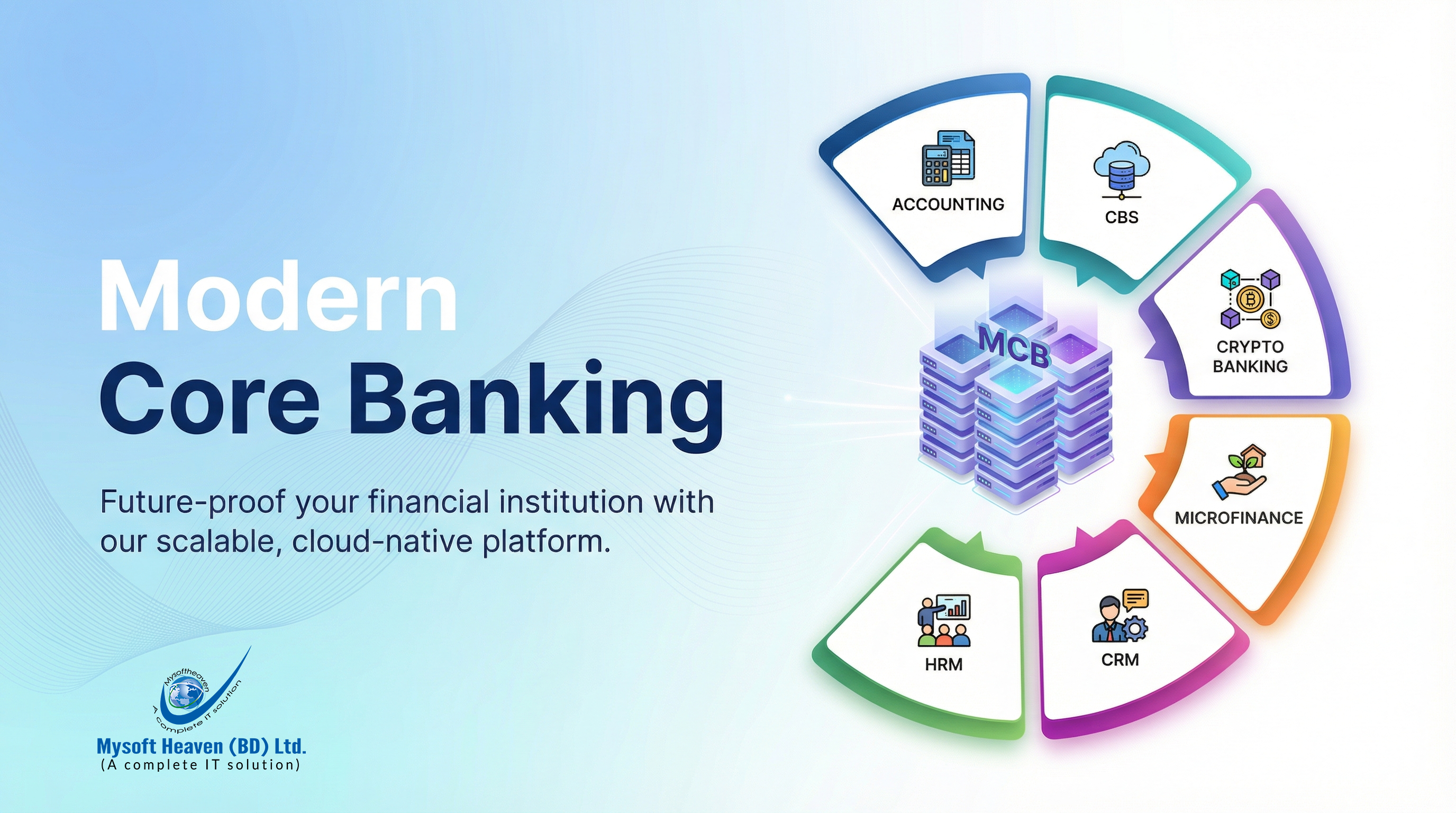
Summary (TL;DR): Core Banking Software (CBS) is the mission-critical engine that runs deposits, loans, payments, ledgers and customer records across a bank’s branches and channels. Modern CBS platforms are moving away from monolithic on-premises systems toward cloud-native, API-first, modular platforms that support real-time processing, composability, regulatory reporting, and embedded intelligence. Implementing or modernizing a core requires careful planning, risk control, vendor selection, data migration discipline, and a roadmap for phased rollout — but the payoff is faster product launches, lower operating cost, better customer experience and improved compliance.
1. What is Core Banking Software?
Core Banking Software (CBS) is the centralized set of systems that manages a financial institution’s essential operations: customer accounts, deposits, withdrawals, payments, loan lifecycle, interest calculations, and the general ledger. Historically it connected branches so a customer could transact anywhere; today it also connects mobile apps, payment gateways, third-party services, and analytics platforms. The phrase CORE historically evokes “Centralized Online Real-time Environment” — underscoring that modern core banking must operate in real-time and present the bank as a single, consistent entity to customers.
2. Why CBS matters (business outcomes)
A bank’s core is not “just software” — it is the operational backbone. Well-designed CBS delivers:
-
Operational efficiency: automates routine back-office rules, reduces manual reconciliations and lowers cost per transaction.
-
Customer experience: faster account opening, real-time balance updates, seamless omnichannel services.
-
Product agility: ability to launch new accounts, loans, cards, or marketplace products quickly.
-
Regulatory compliance & reporting: standardized data, audit trails and automated reporting for AML/KYC/tax.
-
Risk control & resilience: consistent accounting, access controls, and disaster recovery.
These benefits translate into top-line growth (new digital products), bottom-line savings (automation + cloud), and reduced regulatory friction.
3. Core components and functional modules
A modern CBS typically includes these modules:
-
Customer Information Management (CIM): single customer view, KYC/AML attributes.
-
Deposit & Account Management: multiple account types, interest rules, overdrafts.
-
Lending & Loan Lifecycle: origination, approvals, disbursement, repayment schedules.
-
Payments & Transaction Engine: real-time processing, clearing, settlement, RTGS/NRTGS/ACH integration.
-
General Ledger & Accounting: real-time posting, multiple ledgers, multi-currency.
-
Treasury & Liquidity: cash management and mark-to-market where needed.
-
Workflows & Process Engine: approval flows, exception handling, automation.
-
APIs & Integration Layer: connect mobile, internet banking, fintechs, and third-party services.
-
Analytics & BI: operational dashboards, credit scoring and fraud analytics.
-
Security & Audit: roles, encryption, audit logs, secure interfaces.
4. Architectural patterns: old vs. modern
Legacy monoliths (traditional): single large codebase, heavy customization, fragile upgrades, long release cycles.
Modern core architectures (recommended):
-
Cloud-native & microservices: independent services that scale horizontally.
-
API-first / composable: every function is exposed via secure APIs so banks can orchestrate third-party services and internal components.
-
Event-driven & real-time processing: ensures immediate balance updates, notifications and fraud detection.
-
Modular / headless front end: separate customer experience layers (mobile/web) from back-end logic.
Industry observers and vendors note that cloud-native, modular and API-first designs are the primary direction for modern cores. These designs significantly reduce time-to-market for new products and enable continuous delivery.
5. Key features to look for in a modern CBS
When evaluating or building a CBS, prioritize:
-
Real-time transaction processing (no batch delays).
-
API-first connectivity (open banking readiness).
-
Cloud support / hybrid deployment (elastic scale and DR).
-
Configurability without coding (product factory for pricing, tenure, interest rules).
-
Multi-currency & multi-entity accounting.
-
Robust compliance & automated reporting.
-
Extensible data model & metadata-driven design.
-
Built-in observability and monitoring.
-
Security primitives: zero-trust, encryption-at-rest and transit, strong IAM.
-
Operational tooling: test harnesses, sandbox environment, rollback and reconciliation tools.
6. Market trends shaping CBS (2024–2025 and beyond)
Several macro trends are reshaping core banking choices:
-
Cloud migration and SaaS licensing: banks are moving from CAPEX monoliths to subscription or hosted models for faster upgrades and cost flexibility.
-
Composable banking / API ecosystems: banks prefer composable stacks where best-of-breed services are integrated via APIs.
-
AI & analytics embedded in the core: for credit scoring, personalization and fraud detection.
-
Open banking and regulatory shifts: standard APIs and data portability requirements force clearer integration strategies.
-
Real-time clearing & instant payments adoption: consumers expect instant settlement and real-time notifications.
-
Security & resilience focus: as banks adopt cloud, regulators and CISOs demand stronger governance and zero-trust models. The Financial Times and industry analyses highlight that cloud migration brings both benefits and security risks that must be managed.
7. Implementation roadmap — practical steps
Implementing or replacing a core is a strategic program, not a plug-and-play project. A high-level roadmap:
-
Strategic assessment & business case
-
Quantify benefits: TCO, time to market, risk reduction.
-
Define target operating model (product factories, shared services, outsourcing).
-
-
Target architecture & vendor shortlisting
-
Decide cloud vs hybrid vs on-prem, API standards, microservices vs package.
-
Shortlist vendors that match bank scale, product requirements, and regulatory needs.
-
-
Detailed design & data mapping
-
Map current data model to the new model; design reconciliation logic; establish master data governance.
-
-
Phased migration plan
-
Avoid “big bang” where possible. Use parallel run, split by product line, by geographies, or by customer segment.
-
Build cutover playbooks, freeze windows, and fallbacks.
-
-
Testing & quality assurance
-
Unit/integration tests, end-to-end, performance at scale, security tests, compliance checks.
-
-
Training & change management
-
Upskill staff, prepare support teams, and educate customers for new processes.
-
-
Go-live & hypercare
-
Intensive monitoring after launch, immediate bug triage, reconciliation and post-mortem.
-
-
Continuous improvement
-
Adopt CI/CD for non-disruptive feature rollout, monitor KPIs and iterate.
-
Phased migration and strong data migration governance are frequently cited as best practice; several large banks publicize multi-year modernization programs executed in stages rather than in a single cutover.
8. Common pitfalls & how to avoid them
-
Underestimating data migration complexity: banking data is messy and interlinked; reconciliation scripts and parallel runs are essential.
-
Treating core as an IT project only: it’s an enterprise transformation requiring product, ops, risk and compliance stakeholders.
-
Over-customization of vendor packages: excessive customization creates upgrade risk; prefer configuration and well-documented extension points.
-
Ignoring observability & monitoring: poor monitoring causes slow incident response and regulatory headaches.
-
Poor contingency planning for cutover: every production rollout must have tested rollback plans and clear rollback criteria.
Research on CBS implementations (including studies in Bangladesh) highlights that operational and organizational issues (training, process redesign, governance) often drive failure as much as technical issues.
9. Security, compliance & operational resilience
Security is non-negotiable. Key controls:
-
Encryption in transit & at rest; HSMs for key management.
-
Role-based access control and least privilege.
-
Zero-trust network segmentation for cloud deployments.
-
Regular red-team exercises, vulnerability scanning, and threat hunting.
-
Comprehensive audit trails for every financial event.
-
Third-party vendor risk assessments for cloud providers and API partners.
Cloud migration offers scale and DR but introduces shared-responsibility models and novel risks (misconfiguration, supply chain issues). Industry coverage emphasizes that banks moving to cloud must strengthen governance, supplier oversight and security operations.
10. Selecting a CBS vendor — checklist
When evaluating vendors, score them on:
-
Fit to business model: retail, corporate, microfinance, neobank?
-
Modern architecture: cloud-native, API-first, event-driven.
-
Local/regulatory support & localization: local tax, reporting formats, language and currency support.
-
Implementation methodology & local partner presence: availability of local integrators and experienced consultants.
-
Upgrade path & vendor roadmap: how are upgrades handled, cost model (capex vs opex).
-
Operational SLA, disaster recovery and support model.
-
References & proven deployments in similar markets.
Global examples show major banks choosing both third-party platforms (e.g., Temenos, Thought Machine) and custom builds depending on strategy and scale. Recent bank migrations continue to favor vendors with strong cloud & API credentials.
11. Cost considerations and TCO
Costs fall into categories:
-
Software licensing or subscription.
-
Cloud infrastructure & platform costs.
-
Integration and implementation services.
-
Data migration and testing.
-
Ongoing operations, monitoring & support.
-
Regulatory reporting and audit preparedness.
A careful TCO model compares an on-prem monolith’s ongoing maintenance and upgrade churn versus cloud/SaaS with subscription fees and potential operational savings. Market analysts estimate the core banking market in the multiple billions globally, reflecting significant ongoing spending and migration activity.
12. The Bangladesh context — practical notes for local banks
Bangladeshi banks and financial institutions face some unique practicalities:
-
Regulatory & reporting requirements: ensure the core supports Bangladesh Bank reporting formats, tax rules, and AML/KYC flows.
-
Local payment rails & real-time demands: integration with local switches and mobile financial services (MFS) is essential.
-
Skill availability & local partners: successful implementation requires local integrators and experienced operations teams. Past studies of CBS implementation in Bangladeshi banks emphasize governance, capacity building and process redesign as critical success factors.
13. Case examples and recent developments
-
Large bank modernizations: Some major banks (e.g., SBI, Julius Baer) have publicly announced multi-year plans to modernize core infrastructure via vendor platforms or open-source strategies — illustrating that even very large incumbents are moving aggressively to rewrite or replace legacy cores. These moves commonly emphasize microservices, hollowization and cloud migration.
-
Industry vendors & composable stacks: Thought Machine, Temenos, and other modern vendors promote cloud-native, API-first approaches that enable banks to be more agile in launching products. Analysts highlight modularity, blockchain experimentation, and AI as differentiators in 2025.
14. How Mysoftheaven (BD) Ltd can add value
Mysoftheaven (BD) Ltd is positioned to support banks and financial institutions across the CBS lifecycle. Here’s a practical services portfolio that Mysoftheaven can offer:
-
Consultancy & strategy
-
Business case development, target operating model design, vendor shortlisting and procurement support.
-
-
Integration & implementation
-
System integration for payments switches, MFS, BI, regulatory reporting and third-party fintechs.
-
Data migration services (profiling, cleansing, reconciliation scripts and parallel run support).
-
-
Customization & localization
-
Localization for Bangladesh Bank reporting, local tax rules, language and currency formats.
-
Product configuration tools to let banks model deposit/loan products without code.
-
-
Cloud & DevOps
-
Cloud architecture design (public/hybrid), CI/CD pipelines, automated testing harnesses and monitoring stacks.
-
-
Security & compliance
-
PCI/DSS/ISO/other standards alignment, penetration testing, SIEM integration and vendor risk assessments.
-
-
Training & change management
-
Operations manuals, runbooks, training sessions for branch and contact-center staff, hypercare support.
-
-
Managed services & support
-
SLA-based application support, 24/7 NOC options, and managed patching/upgrades.
-
-
Innovation lab
-
Rapid prototyping for new digital products (embedded finance, BNPL, SME lending flows), PoCs with AI scoring, and sandbox APIs for partners.
-
Mysoftheaven can position itself as a trusted local partner that pairs international best practices (cloud, API, event-driven design) with deep local knowledge of Bangladesh compliance and payment rails.
15. Practical checklist for getting started (for bank CIO/CRO)
If your bank is ready to evaluate or modernize the core, start with:
-
Assemble a cross-functional steering committee (IT, risk, finance, ops, legal).
-
Run a 3–6 month discovery: map current processes, measure running costs, and draft an ideal target operating model.
-
Prioritize: choose a pilot product (e.g., retail savings + payments or a digital account) to migrate first.
-
Select a vendor with cloud-native credentials and local implementation experience.
-
Build a data migration lab: run sample cutovers and reconciliation tests until stable.
-
Prepare communications and customer impact plans (fees, cutover times, channel outages).
16. Measuring success — KPIs post-implementation
Track these to ensure the program delivers value:
-
Time to market for new products (days/weeks).
-
Transaction latency (ms for core transactions).
-
Operational cost per transaction.
-
Incidents MTTR (mean time to resolution).
-
Compliance & audit findings (number/severity).
-
Customer NPS / digital adoption metrics.
17. Final thoughts (pragmatic counsel)
Core banking modernization is strategic and challenging, but it is also essential. The shift is driven by customer expectations (real-time, digital), competitive threats from fintechs, and regulators pushing for openness and stronger controls. Modern architectures — cloud-native, API-first, modular — are no longer “nice to have”; they are the baseline for banks that want to remain relevant and profitable over the next decade. Industry evidence shows that thoughtful, phased modernization (backed by proper governance, data discipline and security) yields measurable product agility, cost savings and improved customer experience.
Here are Core Banking Software – FAQs tailored for Mysoftheaven (BD) Ltd.
If you want, I can also attach them to your article as a separate section or prepare them for website use.
Frequently Asked Questions (FAQ) – Core Banking Software
1. What is Core Banking Software?
Core Banking Software (CBS) is a centralized digital system that manages a bank’s essential operations—such as customer accounts, deposits, loans, payments, interest calculations, and reporting—across all branches and channels.
2. Why do banks need Core Banking Software?
Banks need CBS to ensure real-time transactions, improve customer service, reduce operational cost, support regulatory compliance, and provide seamless access to accounts through ATM, mobile, and internet banking.
3. How does Core Banking Software work?
CBS connects all branches and channels to a single real-time system. Every transaction (deposit, withdrawal, transfer, loan EMI, etc.) updates customer records and the general ledger instantly, ensuring accuracy and consistency.
4. What are the core modules included in modern CBS?
Common modules include:
-
Customer Information Management
-
Deposit & Savings Accounts
-
Loan Management
-
Payments & Transfers
-
General Ledger & Accounting
-
Treasury & Cash Management
-
Compliance & Reporting
-
API Integration Layer
-
Security & Audit Management
5. What are the benefits of using a modern CBS?
A modern core provides:
-
Faster product launch capability
-
Real-time processing
-
Reduced system downtime
-
Better customer experience
-
Strong security and compliance
-
Lower operational costs
-
Easy integration with mobile, internet banking & third-party services
6. Can CBS integrate with other platforms?
Yes. Modern CBS is API-enabled and integrates easily with:
-
Mobile banking apps
-
Internet banking
-
Agent banking
-
Payment gateways
-
Fintech services
-
Bangladesh Bank reporting portals
-
Third-party risk, AML, and ERP systems
7. Is Cloud-based Core Banking safe?
Yes. Cloud CBS uses advanced encryption, role-based access control, firewalls, disaster recovery setup, and compliance frameworks like ISO, PCI-DSS, and SOC certifications. It is more secure than many outdated on-premises systems when configured correctly.
8. How long does it take to implement a Core Banking System?
Implementation time varies depending on size and complexity:
-
Small institution: 4–6 months
-
Medium-sized bank/MFI: 6–12 months
-
Large bank: 12–24 months
This includes data migration, customization, integration, testing, and training.
9. What challenges do banks face during CBS implementation?
Major challenges include:
-
Data migration complexity
-
Staff training and change management
-
Integration with legacy systems
-
Over-customization
-
Ensuring regulatory compliance
Mysoftheaven can help overcome all these with structured project management.
10. What is the difference between legacy CBS and modern CBS?
Legacy CBS:
-
Monolithic
-
Hard to upgrade
-
Often batch-based
-
Limited integration
Modern CBS:
-
Cloud-native
-
API-first
-
Real-time
-
Highly scalable
-
Easy to integrate with fintechs
11. What security features should CBS have?
A strong CBS must include:
-
Multi-factor authentication
-
Data encryption
-
Transaction monitoring
-
Role-based access
-
Audit trails
-
Fraud detection
-
Disaster recovery / backup system
12. Does CBS support Bangladesh Bank compliance?
Yes. A properly localized CBS supports:
-
eKYC
-
AML/CFT screening
-
Treasury reporting
-
Foreign exchange regulations
-
BB API integration (RTGS, EFTN, BEFTN)
Mysoftheaven implements all local compliance needs.
13. What types of financial institutions can use CBS?
-
Commercial banks
-
Islamic banks
-
Microfinance institutions (MFI)
-
Non-banking financial institutions (NBFI)
-
Agent banking organizations
-
Digital/mobile banks
-
Cooperative societies
14. Can CBS support Islamic/Shariah banking?
Yes. Modern CBS can support Islamic products such as Mudarabah, Murabaha, Ijara, Musharaka, and profit-sharing schemes with accurate Shariah-compliant accounting.
15. How does Mysoftheaven (BD) Ltd help in Core Banking implementation?
Mysoftheaven provides:
-
Requirement analysis & vendor selection
-
Customization & local compliance setup
-
Data migration & integration support
-
Cloud/on-prem deployment
-
Staff training
-
24/7 technical support
-
Maintenance and upgrades
16. Can CBS improve customer experience?
Absolutely. CBS enables:
-
Real-time balance updates
-
Faster transactions
-
Instant account opening
-
Digital banking access
-
Personalized products
-
Seamless omnichannel service
17. Does CBS reduce operational cost?
Yes. Automation, centralized processing, cloud optimization, and reduced manual work significantly lower operational expenses over time.
18. Is training required for CBS users?
Yes. Training for operational staff, IT teams, branch employees, and customer support ensures smooth adoption and reduces errors.
19. How often are updates or upgrades required?
Most modern CBS follow scheduled quarterly or semi-annual updates, while cloud-based systems receive continuous upgrades with minimal disruption.
20. How can a bank choose the right CBS?
Consider these factors:
-
Functional fit
-
Scalability
-
Local compliance support
-
Integration capabilities
-
Deployment model (cloud/on-prem)
-
Vendor experience & support
-
Cost & licensing flexibility
Mysoftheaven assists banks in evaluating and selecting the best-fit core.